THE BIRTH OF A VINEYARD
Chapter One: Poles and Posts Chapter Two: Irrigation Chapter Three: The Winery Chapter Four: Cultivation Chapter Five: The Vines Home Go to newest posting Declaring our intent.
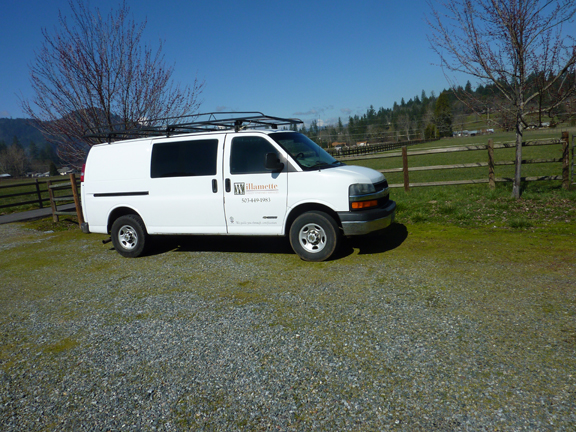
March 8, 2013 A big day at the Crow and Bear— Our vineyard management service arrives.
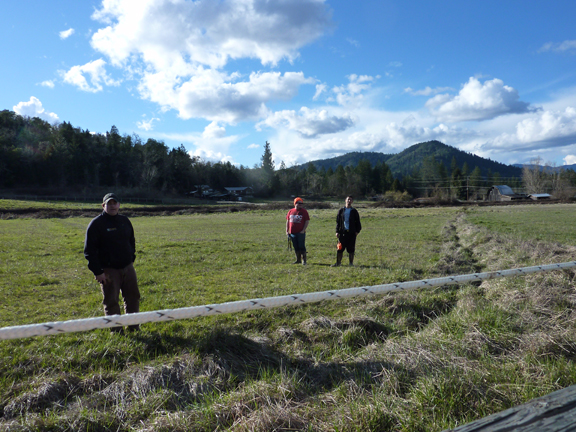
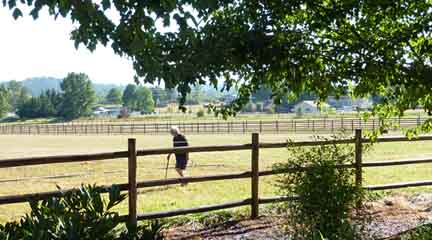
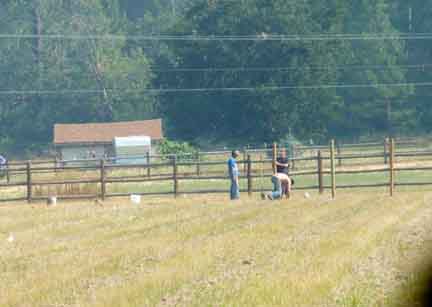
It takes three men, but only three, to survey the blocks. Blocks are laid out in squares of 100 feet oriented to true north and south, then tilted three to four degrees to the west, for maximum sun exposure. Steve Shore, of Willamette Valley Vineyard Services, and his helpers Armando and Rico do the honors.
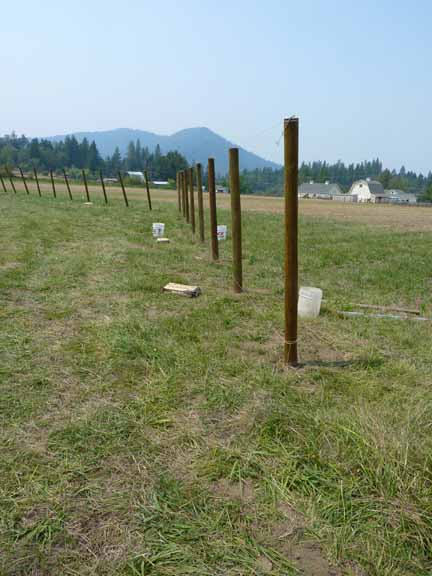
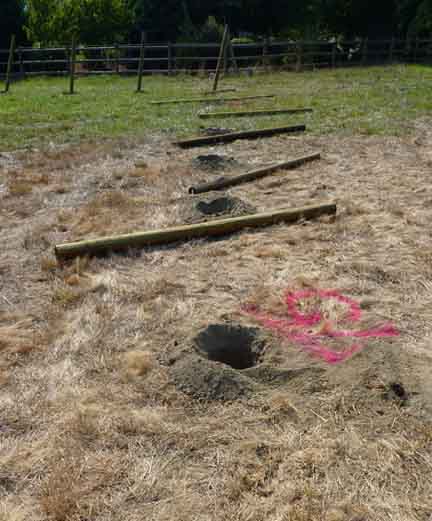
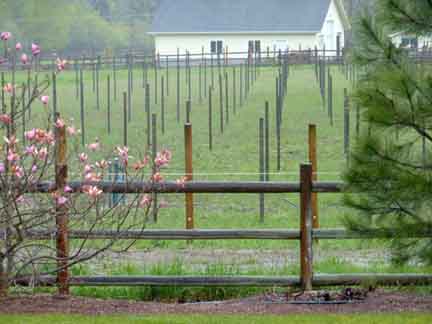
End posts of Doug fir will support the trellises.
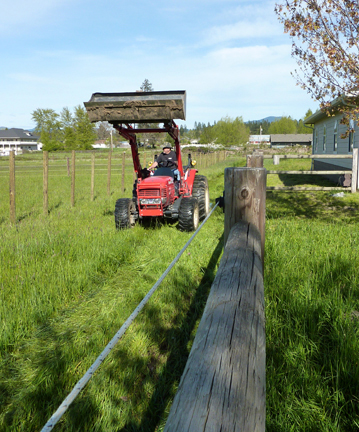
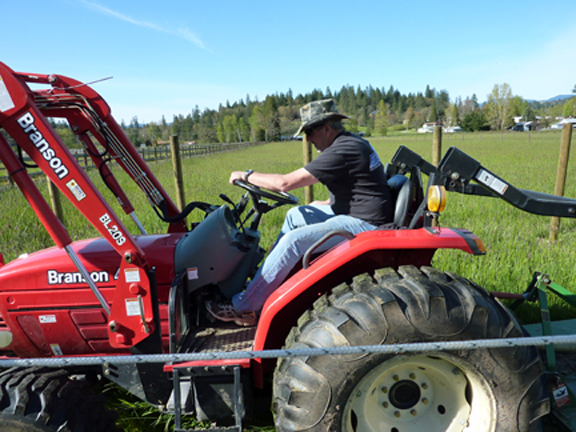
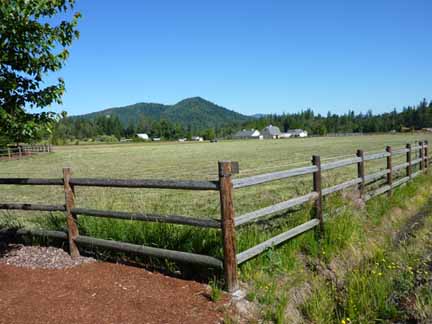
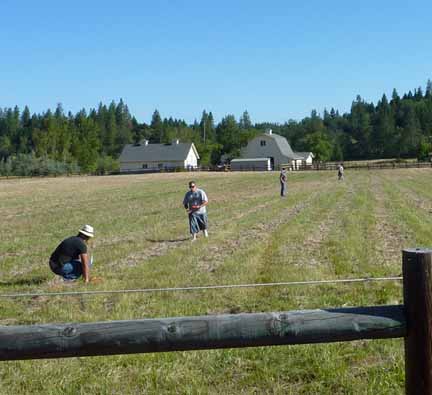
Our fifteen irrigated acres will translate to what Steve calls twenty-five "vine acres" of wine grapes, consisting of some 27,000 individual vines. Planting will commence in June. We're putting in two clones of Pinot Noir, some Syrah, a little Tempranillo, and a smattering of Merlot. April 18. Our land has been in hay. This now needs to be mowed. What remains will serve as a cover crop for the rows of vines. Harry Knight arrives to mow. In the east field, he has to jockey around the end posts in place.
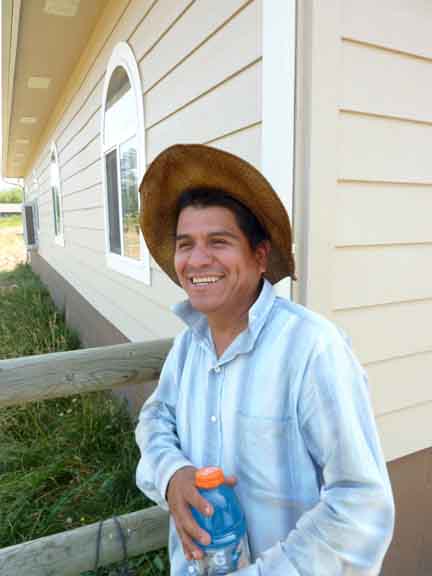
Hi, Harry.
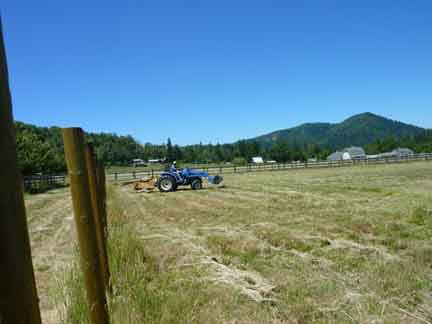
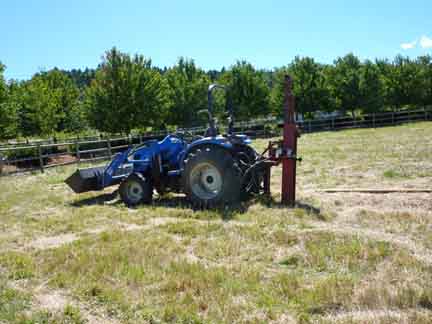
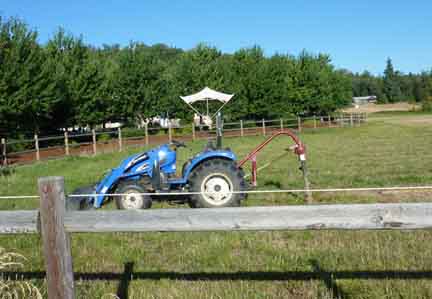
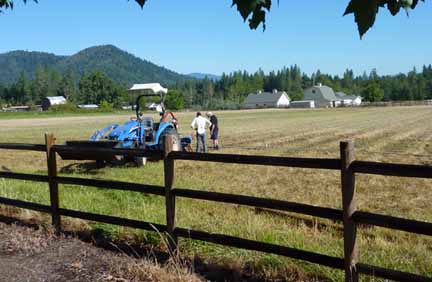
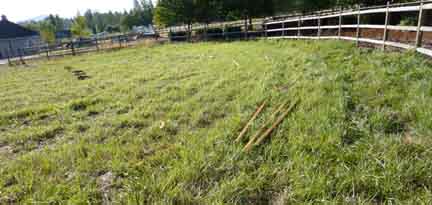
June 4. Out in the vineyard-to-be, Armando comes for a second mowing. Can you spot his tractor out there at the other end of the west field?
Now it's time to start tilling the fields. Cesár does the honors in the east field with the poles.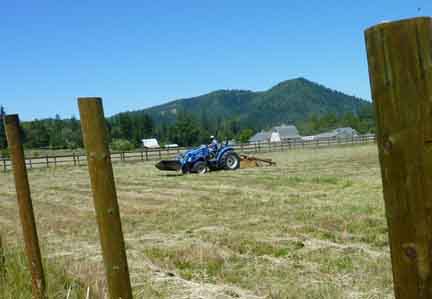
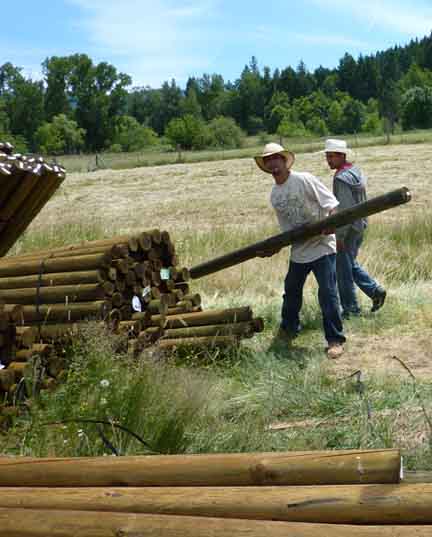
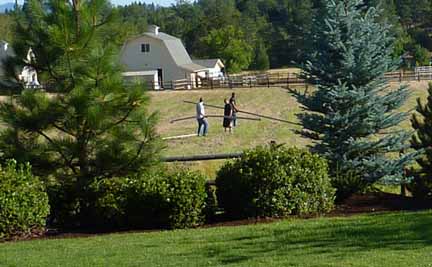
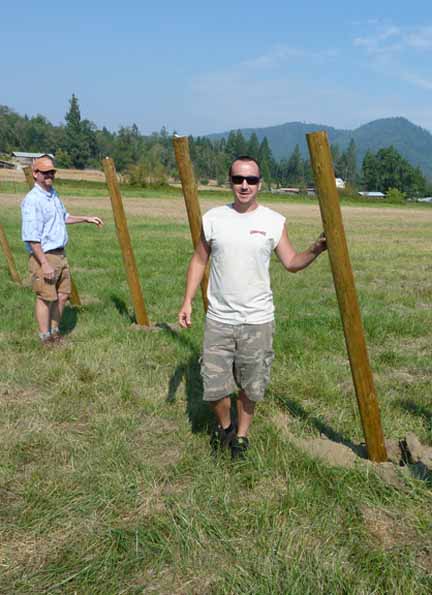
June 15. In the fields, there are more poles to be placed. Armando and helper move some poles to the large west field.
Little flags mark the corners of the 100-foot blocks.
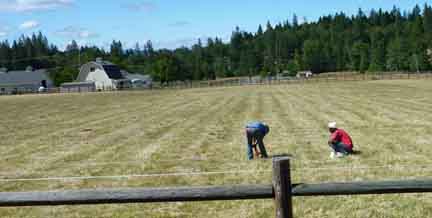
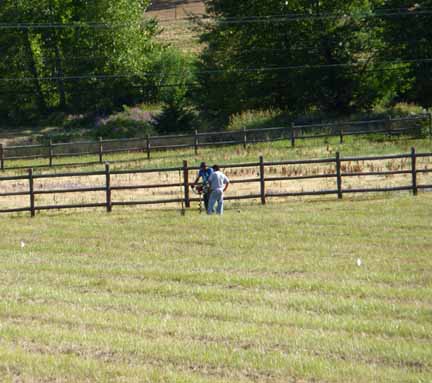
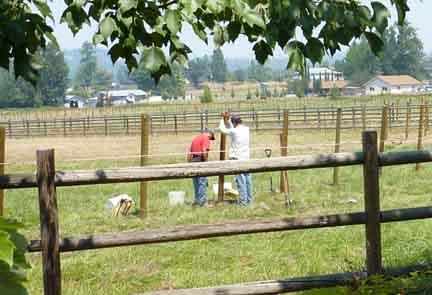
Between the flags, more markers are placed at 6-foot intervals. Armando and Cesár carefully place each of these small markers in the west field. End posts will go here.
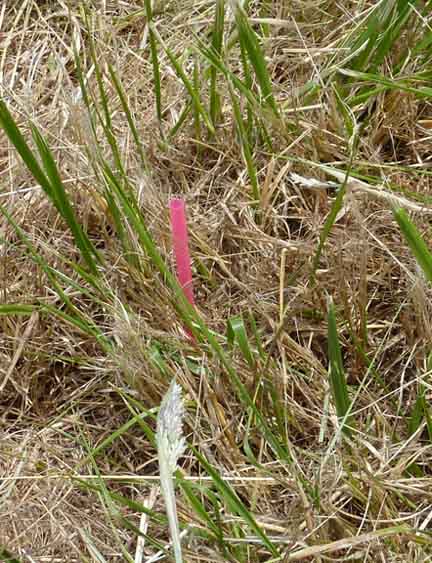
The small, 6-foot markers are an ingenious adaptation. Each is a simple drinking straw into which has been inserted a T-bent high-tensile wire. The wire goes into the ground, the bright pink straw protrudes to mark the spot. Our fields will end up with thousands of these straws, each one marking the exact place a vine is to be planted.
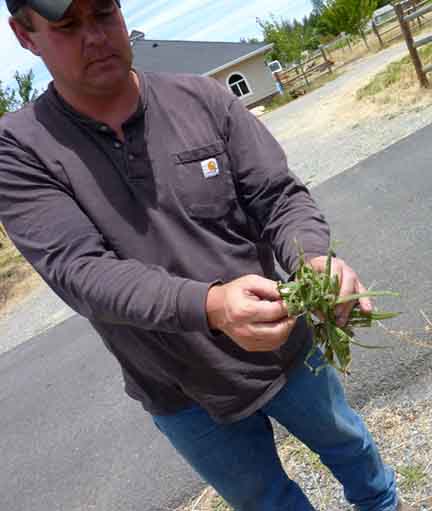
Steve Shore, our vineyard manager, shows us a plant enemy: a sticky weed, whose sap gums up implements and machinery.
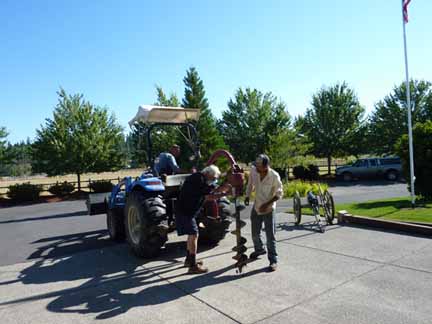
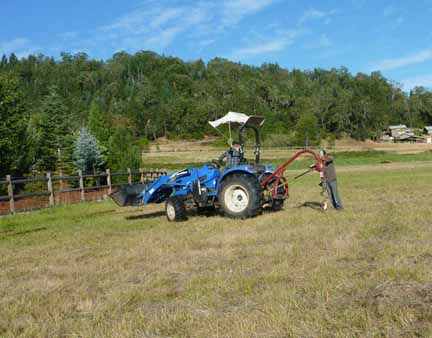
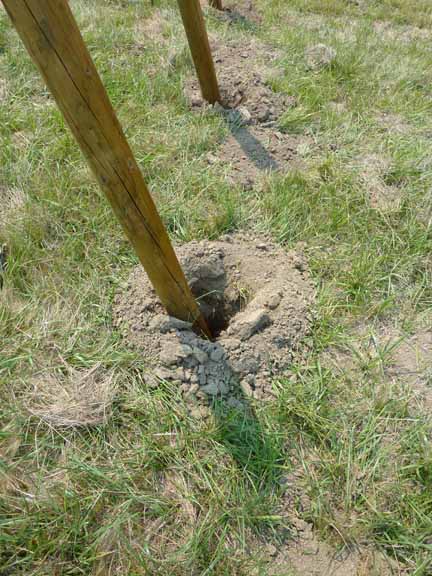
June 21. In the fields, work is stalled. Cesár and Armando tried to pound posts into place in the west field, but the ground is now too hard. The tractor awaits an auger.
June 28. Seven days later, work in the large west field is still stalled.
Now, on June 29, the soil in the fields is almost as hard as it was in the barrel room. Armando and helper struggle to auger post holes at the end of the west field. The weather bureau is predicting 95º today.
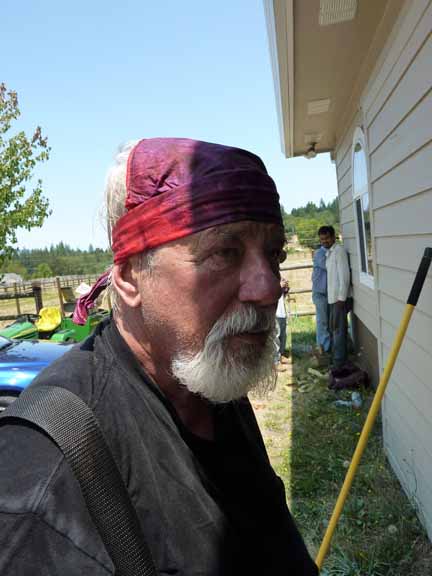
In the heat of the day, Armando and Raul bring the dulled auger blade to Matt, hoping he can sharpen it. It's a good thing Matt has a well-provided shop, but this post-hole job needs more than a sharpened auger blade to succeed. July 1. The last couple of days have been cloudless and hot. Tomorrow the weatherman is predicting 100º. Bandana keeps the sweat from Matt's eyes.
I ask Armando when the vines can go in the ground. Armando explains that his crew needs to finish placing the plant markers first. Soon, he expects a work crew of 15 to 25 people to do the actual planting, and when I ask "¿Cuando?" he replies that they have to place the markers first. Again, I ask "¿Cuando?" whereupon Raul, the irrigation specialist, takes my meaning. "Miércoles o Jueves," comes the reply. Wednesday or Thursday.
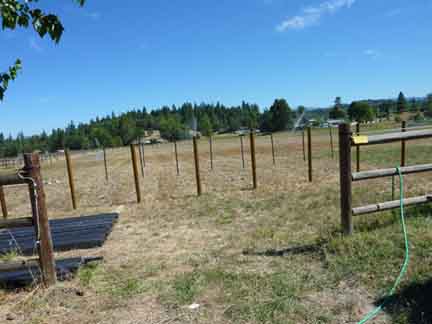
July 3. The east field, about half our vineyard area, is now poled and flagged, awaiting installation of the drip line irrigation and planting of the vines. The large west field and the farthest, smallest west field still await these poles.
July 4. The soil is parched.
The fields are uninhabited.
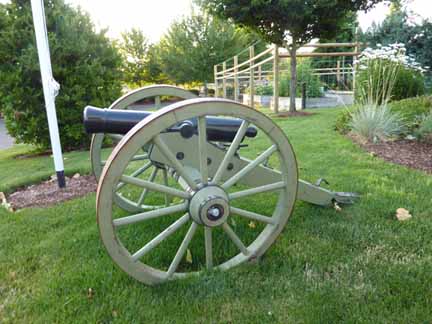
Nobody works on the Fourth of July. But we have been invited to a newcomers' potluck: bring your own bottle and your own fireworks. Matt plans to bring his cannon.
July 5. The weather bureau is predicting a high of 86º the lowest we will have seen in a couple of weeks. Today's the day the busload of workers should arrive to plant that poled east field. The key word here is should. We watch the entry road in keen anticipation. July 10.
Our current crop . . .
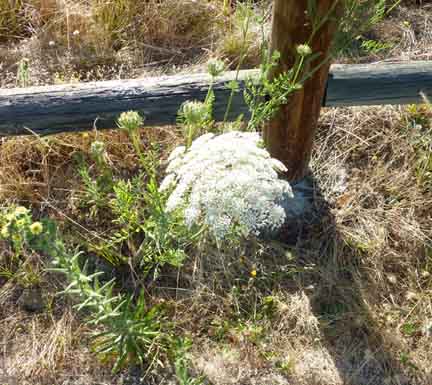
Did you know that Queen Anne's Lace is a wild descendant of the humble carrot, brought from England? Friday, July 12. A small crew is working in the large west field today. They have brought a tractor with a 3-point auger. This is working much better to drill those post holes the west fields require. We devoutly hope work can continue so that our entire 15 acres can boast end poles ready to receive trellises and drip lines and, one of these days, grape vines. Saturday, July 13. Today five men appeared in the large west field, the largest crew we have seen yet. They appeared to be measuring . . . planting lines?
Wednesday, July 17. The five men who came on Saturday spent a few hours taking measurements and trying to dig some more post holes, but the soil was too hard for even the 3-point auger. The tractor is sitting where they left it on Saturday. No more poles have been planted. It's expected to be a hot weekend.
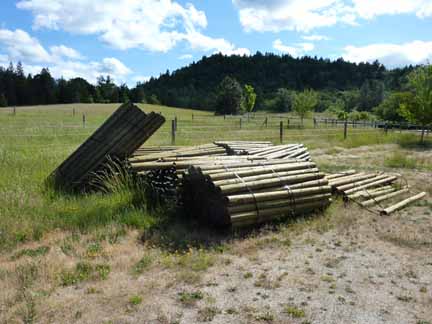
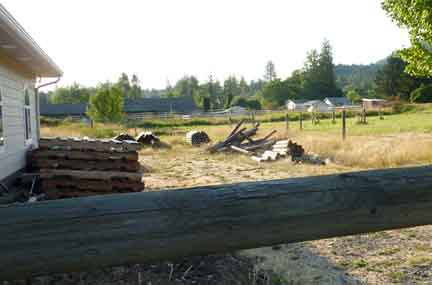
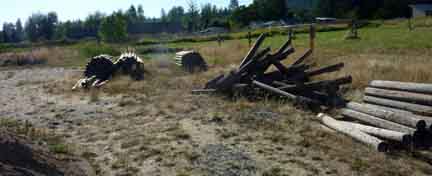
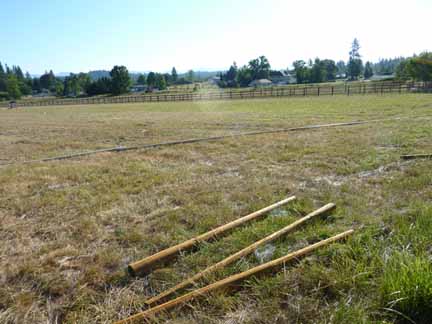
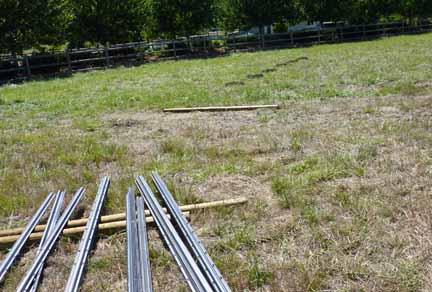
Friday, July 19. Work is stalled. This pile of poles must be planted before any vines can go in the west fields.
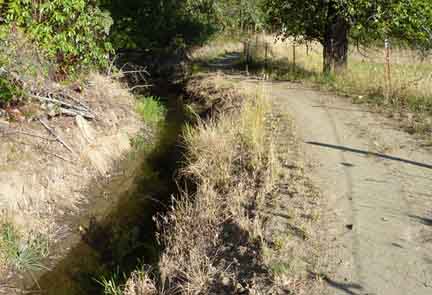
But poles can't be planted in rock-hard ground. Now it's all about the water. The Crow and Bear receives its irrigation water from the Rogue River. Brought from the Rogue through a series of aqueducts, the water is delivered by irrigation ditch.
If you're "on the ditch," you must pay a yearly subscription fee. Your days to receive water are predetermined. Ours are days ending with a 0, a 1, or a 2. Tomorrow is July 20. It will be a water day.
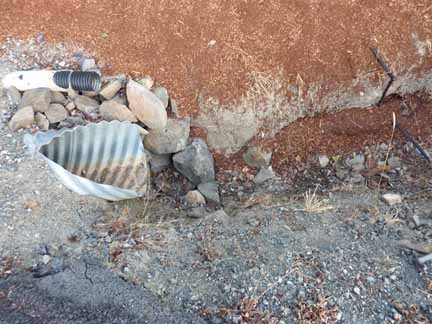
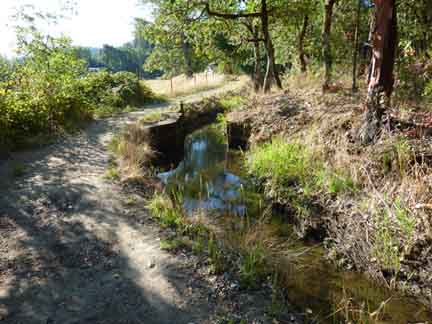
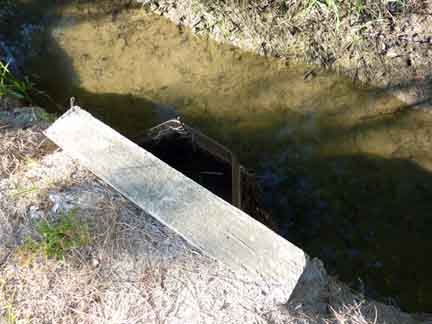
Each ditch subscriber is assigned a weir and valve.
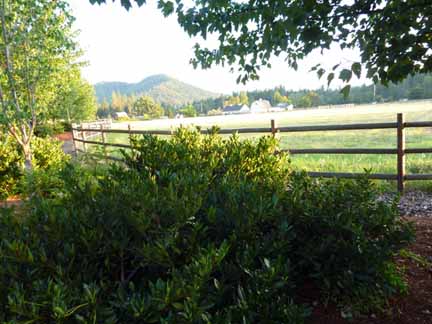
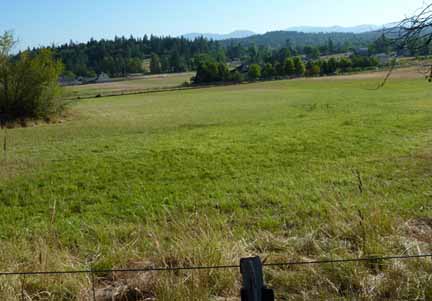
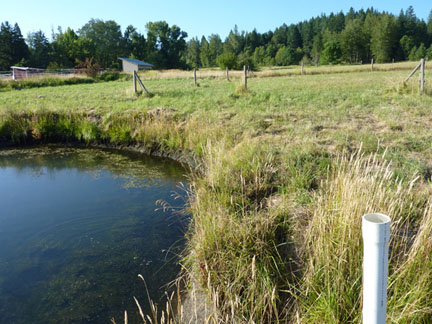
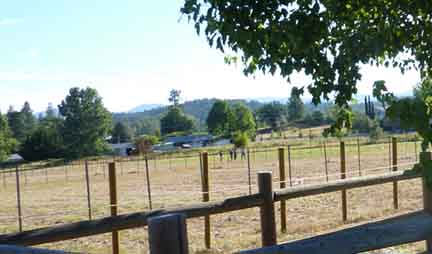
From our weir, the water flows through an underground pipe to our far distant holding pond beside the winery. That's it on the upper right, framed by the tree branches in the foreground.
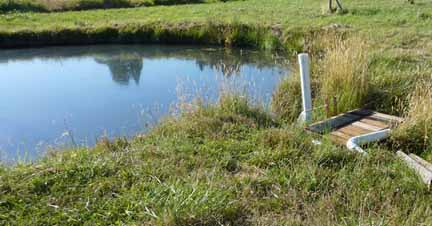
At the holding pond, a standing pipe delivers our alloted water.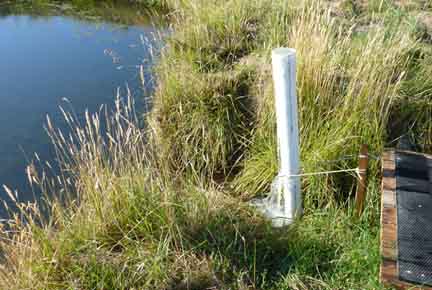
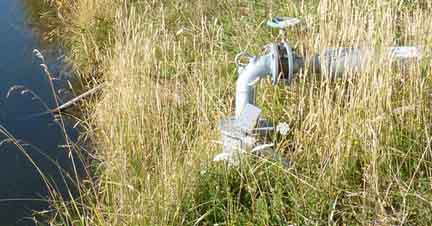
From the holding pond, a 7hp pump sends water through the system. Seven horsepower delivers too much pressure for our intended drip lines, so some accommodation will have to be made once we're using it for that purpose.
Right now, that pressure will be welcome. It will be needed to send water through the leased aluminum pipe that Tom Fey, the contracted irrigation specialist, has provided so sprinklers can moisten our parched soil so the poles can be planted so the vines can be planted. (Sprinklers were not needed back in April, when the east field poles were installed and the soil was still malleable.)
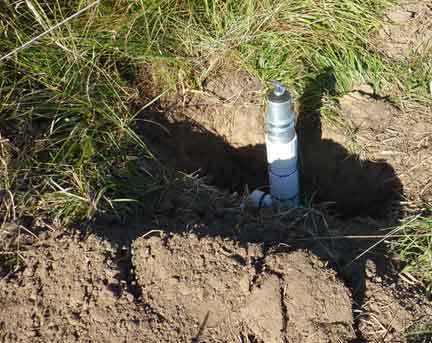
One obstacle prevents water flowing through those pipes right now: early on, four risers were broken by tractor work. Three were repaired yesterday. The fourth is promised for today.
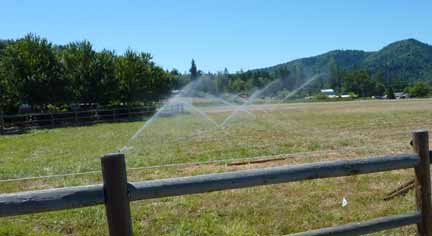
The fourth riser has been fixed; water is now gushing through the sprinklers that will soften the soil enough to dig holes for the posts. It is a joyful sight.
July 20. Matt has been given a schedule for the valves serving the sprinkler system. He has followed this schedule religiously, but this morning water is down to a trickle and the pond is so low he has had to turn off the pump lest it incur damage from running dry.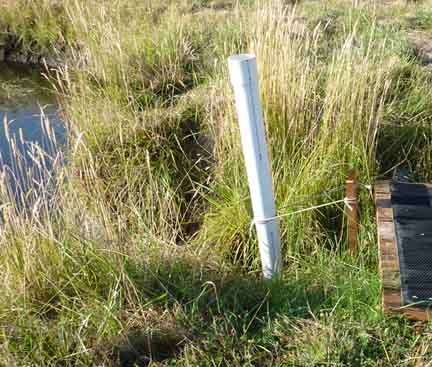
Matt has "ridden the ditch" and discovered a blockage at the uphill neighbor's weir. He has cleared the weir as best he could with the tools at hand (a stick), but he will return later today with better tools. The ditch management company is not available because it is the weekend. They say, "Call back on Monday." But we need the water now. We are becoming our own management company. Today 109 metal line posts were delivered from Southern Oregon Vineyard Management Company, a division of Willamette Valley Vineyard Services. Another 500 are promised us. Three burly young men arrived with the 109 posts. They tried manually pounding them in the east field, but had to surrender to the rock-hard soil. They said that tomorrow they're going to return and try a power tool. We're thinking it's going to take a few long, soaking rains to return the soil in that field to the malleable state it displayed in April and May, when the wooden end poles were first put in the east field. [Observer's Note: It feels to me as if this field work is running athwart the gods. Wouldn't it have been easier to work with the weather, instead of against it?] Sunset, July 20 Matt, stoic soldier, didn't tell me he'd injured his knee digging out the weir. But this evening he's walking with a cane, a rare condescension to pain. Growing restive at the electric bills needed to pump water to soften the fields so poles can be planted so grapes can be planted, he threatens tomorrow to drive the tractor with the 3-point auger (the tractor that has been sitting idle since its abandonment all those days ago) out into the west field to test whether holes can yet be dug. I am worried. Dusk, July 20 Matt just came limping in, wincing. He sat a full minute to catch his breath before telling me he'd hand-dug a successful hole in the wet west field. There is no excuse for poles not being planted tomorrow. Except tomorrow is Sunday. They tell us no work crew is available this Sunday. Sunday, July 21. Dave, the project manager for Southern Oregon Vineyard Management Services, shows up with a helper. They set out to drill a test hole in the west field. Matt walks out to monitor progress.
Here comes the test hole.
Measuring the depth of the test hole.
Not deep enough. Maybe the bit's not sharp enough? Back to Matt's shop.
This evening we receive a scare: the ditch stops running. Matt goes back up to check for blockages, but the water's simply too low. He phones the ditch rider, who returns his call and says that every so often, people take water out of turn or without authorization. He figures that's what's happened now. Monday, July 22 By morning the ditch is running again. A small crew shows up to move pipe to the east field, which now needs irrigation to soften the ground so they can install metal line posts.
The crew digs six holes for end poles in the west field. Only six. The soil must not be moist enough, or surely they would have dug more holes?
They try pounding the metal line posts in the east field, but because the soil is still too hard, it's causing damage to the posts. Watering continues.
The crew departs by 12:30. No one else shows up for field work. Tuesday, July 23 At 0800 a crew of seven arrives. Six speak only English. One speaks only Spanish. As is my custom, I go out, camera in hand, to greet and thank them for the day's work that lies ahead. Kristen, a former Army medic, can swing aluminum pipe and drive tractor with the best of them. "Have you seen Abel?" she asks me. Abel the taciturn and humble, an experienced vineyard hand, appears from the west field. He seems concerned. Questioning him, I learn that he fears that if the present line of holes continues on course, there won't be enough room for the tractor turn-around, which requires thirty feet.
"What about that second block?" I ask him, thinking of the sprinklers that have been running for three days straight. Measurements are taken. The second block allows thirty feet eleven inches before the fence. Kristen brings the tractor to test if the soil can be augered.
Eight holes are dug before a halt is called by management. Work is to focus on the east field. They get twenty more metal line posts installed before calling it a day.
Wednesday, July 24 Crew arrives at 0800 to continue installing metal line posts in the east field.
They get in about an hour's work, but the ground is still too hard. Matt turns on the sprinklers again. The crew departs. The sprinklers have been running all day.
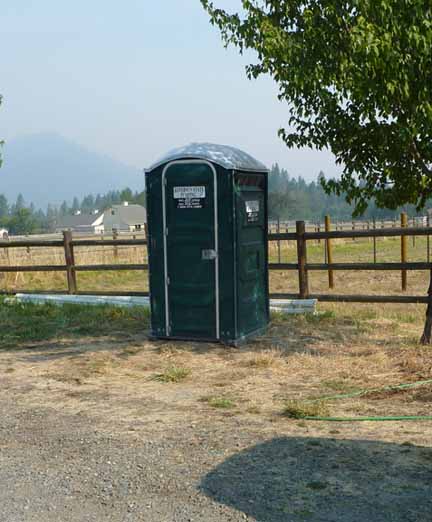
Thursday, July 25 Matt had the sprinklers going in that east field all night. A crew of four showed up at 0800, pounded in what few posts they could, and left. The ground is still too hard, they say. We now have 220 metal line posts in the east field, about a third of what's needed. The rest of the line posts sit in a pile, waiting for the right set of circumstances. Friday, July 26. The only thing new is a Porta-Potty, delivered this morning. It rests out in front of the winery. We are sure the workers—if they ever stay around long enough to need it— will be relieved to have it.
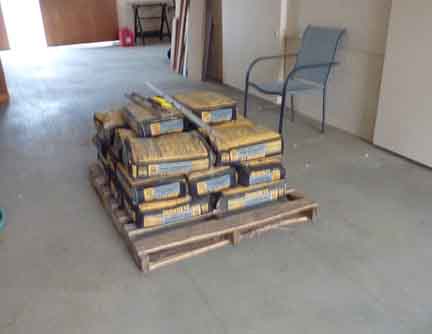
Three crew showed up this morning at 0800. They declared the east field still too hard to pound steel line posts. They were going to put wooden end poles in those holes in the west field, but had no concrete. So they left. We thought they were going for concrete, but at 1600 they still had not returned. So for today, progress = Porta-Potty. [NOTE: On Saturday we learn that the crew had to respond to an emergency with a pump at Tirosh, our friend Harry Knight's new vineyard. We wish Harry all the best.] Saturday, July 27. No action at all in the fields today, but we met with the head of the vineyard management company, who has promised us that by next week at this time, all wooden poles will have been installed in the west field. That will be a gladsome sight. We are keeping our fingers crossed. Sunday, July 28. It being Sunday, there was, of course, no work in the fields. But toward dusk a truck pulling a flatbed drove in, offloaded 15 bags of concrete, onloaded 75 wooden end poles, and left. We had been promised some lengths of PVC irrigation pipe, but none showed up on the truck. Score for the day: Bags of concrete . . . +15 Wooden end poles . . . -75 Irrigation pipe . . . 0 Monday, July 29. A crew of three showed up early (but not bright: wildfires in the area have made sullen the skies). They planted 46 wooden end poles in the west field, not a bad morning's work.
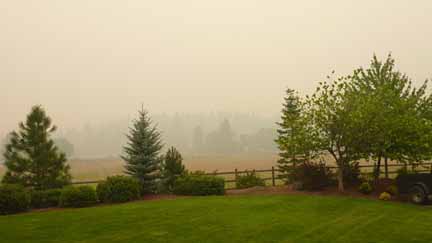
Tuesday, July 30. Today Armando delivered PVC pipe for the sub mains, probably enough to do all the fields. He's the only worker we've seen all day, and that was just for a delivery. Nevertheless, we appreciate his having come out today. And thereby hangs a tale. You see, it's a ditch day. We're entitled today, tomorrow, and the next two days to take water from the ditch (for those are days that end in a 0, 1, or 2). And oh my, the soil needs it. Our rock-hard east field still lacks half its complement of metal line posts. Watering would soften that field enough to allow the posts to be pounded in. But wildfires throughout Southern Oregon have turned our fields ghostly gray.
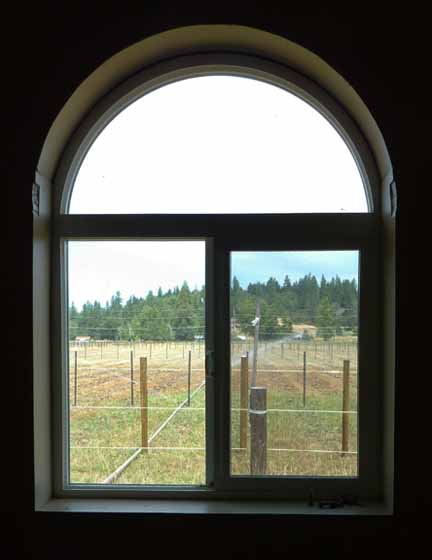
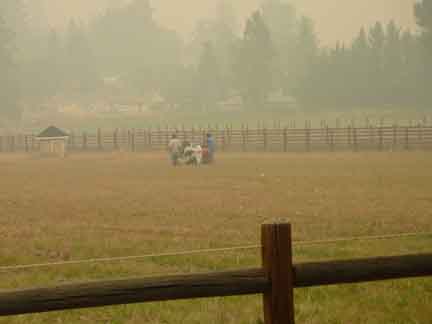
Visibility is so poor we can't see beyond the line of trees across the road. The particulate matter index is so high, workers can't be sent into the fields today. We have three ditch days left, and no guarantees workers will be able to come tomorrow, or tomorrow's tomorrow. We are caught between fire and water. And then, a surprise. Walking out to take the picture you see above, I see . . . Armando and Cesár walking a machine, a heavy-duty post-hole digging machine, out into the west field.
I feel like cheering. And offering them una cerveza. Wednesday, July 31. Armando and two helpers arrived about 9:30, equipped with particle masks. It's an accessory a lot of people were wearing today, in town. We were relieved to see the crew with some measure of breathing protection, though nothing helps the stinging eyes. Armando reports that the Dingo performed excellently. He wishes they'd had it a month ago, when they were trying to dig holes with a 3-point auger. About 300 holes remain to be dug in the west field, but today the Governor of Oregon declared a state of emergency due to the wildfires still raging. Truly, and more than ever, this project seems to be running athwart the gods. Saturday, August 3. Wednesday was the worst. According to the Oregon Department of Environmental Quality, air in our area was in the officially Hazardous range. In town, shoppers and workers were wearing particle masks. Our neighbor saw one person with a Cold War era gas mask. I went shopping for some house plants, thinking that might up the indoor oxygen level, anyway. The workers at Chet's Nursery were all wearing particle masks. They offered me one. When I got home with the pothos, I said to Matt, "If you love me, take me away from this for a day or two." And he does. So he did. In Florence, on the coast, there was not a room to be had this morning— nor, indeed, were there any vacancies that we could see, upon our return, as far south as Reedsport and some ways inland. Every inn wore a No Vacancy sign. It had been restorative, for two nights, to leave the window open all night to the sweet sea air. Last night, through that open window, I'd overheard another wildfire refugee, in the parking lot below, explaining to a stranger why he'd headed north and westward on his motorcycle. And I got it. I really and truly "got it." This morning I was glad we'd been able to enjoy two days of clean, fresh sea air, but today it was time to return. What would we find? we wondered. Lo and behold, in our absence the fields had sprouted wooden end poles. Like mushrooms after a rain, they seemed to us to have sprung up overnight. At 3:15 we found Abel and Raul (newly back from five days in hospital) still installing poles, pouring concrete into the relatively few remaining holes. They were hungry, but working hard.
We took them out a snack to express our thanks. Sunday, August 4 (but only barely) And now, indulge me in a brief, philosophical aside. It is, after all, God's day, though only just begun and no daylight to be in sight for hours. (Or if it's troublesome, just skip this part.) Many years ago Aurelio, son of Audifas "Trabajo, trabajo, la vida es nada más que trabajo" (Life is nothing but work) enjoined me, "Linda, nunca, nunca olvide a los pobres." (Never forget the poor among us.) Hearing the stories of those who stayed while we escaped the smoke, I ponder their daily struggle, the demons and heroes they assign, their hopes and fears and hungers and small joys, and I think, This is what it takes to grow a field of poles or a field of grapes. The stories, all the stories we tell ourselves about ourselves and about the others around us, are intertwined like the roots of the nascent vines, the vines that could not endure in this soil as it now is. It is never a simple raisin. It is never a simple glass of wine. It is all the lives it took to grow that grape, ferment and age that vintage. All the stories, the myriad layers of stories, the perplexity of lives, they are all there, in the wine.
Sunday, after sunrise Fred Meyer opens at 7 a.m. An early morning grocery run makes use of the coolest part of the day. Walking back to our indigo Avalon, dusted lightly with ash, we pass a dozen young firefighters in maroon t-shirts, brought to Freddie's by a transport van emblazoned Roosevelt Hotshots. We flash them two thumbs up and a quiet "Thank you." In return, a nod, a smile, a quiet, "That's OK." Courage comes in many colors. Monday, August 5. Today I surveyed the field of newly planted poles, promised a week ago Saturday and, apparently, promise fulfilled this Saturday past. One pole stood askew. "Come on, Matt," I said. "Let's fix it. There's the sack of cement. How hard could it be to pour it in the hole? After all, you and I packed out of the Humboldt County ranch all by ourselves, with no one to help us. How hard could this be?" But Matt, more versed in affairs of hard labor than I, drove out on his little tractor for a closer look. An entire line looked like this:
but, upon close inspection, turned out to be this:
Forty-seven poles are set loose in empty holes, by today's actual count. A couple dozen sacks of concrete lie beside them. No one has been sent to finish the job. Matt, tomorrow, sees an orthopedist for that damaged knee. And I . . . I must admit that I am somewhat past my heavy labor prime. The management company said they would not come back today. Nor tomorrow. Now we DON'T want rain. Tuesday, August 6. Tomorrow's forecast: "A stray shower or thunderstorm is possible." No word from the vineyard management company. Matt and Michael brought into the winery the sacks of cement that had been left in the field— twenty-three by my actual count. No point in a shower or an evening's heavy dew turning them to stone.
Wednesday, August 7 4:10 p.m. Good thing Matt and Michael brought in those sacks of concrete. It's raining. At least their rescuing the concrete provides some small mitigation of damages. Thursday, August 8. 5:45 a.m. What held so much promise turned out to be merely a tease. The rain, I mean. It proved to be a mere sprinkle, nothing more. And yet . . . and yet, as I always tell Matt, "Bless those who disappoint you." At least the unfilled holes haven't caved in. The mantra continues, "Bless those who disappoint you, for they are leading you toward a better path." Indeed. We have arranged with our landscape contractor to send a crew on Saturday, to finish pouring concrete in those unfilled post holes. Perhaps by then the smoke will have abated, and we will see clearer skies. Our spirits are rising. A new day is dawning at the Crow and Bear.
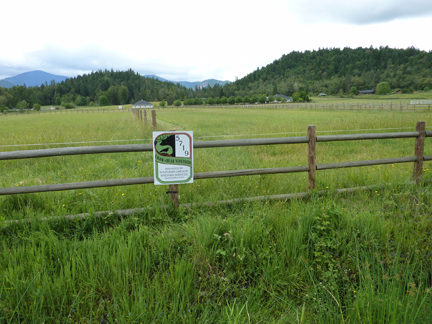
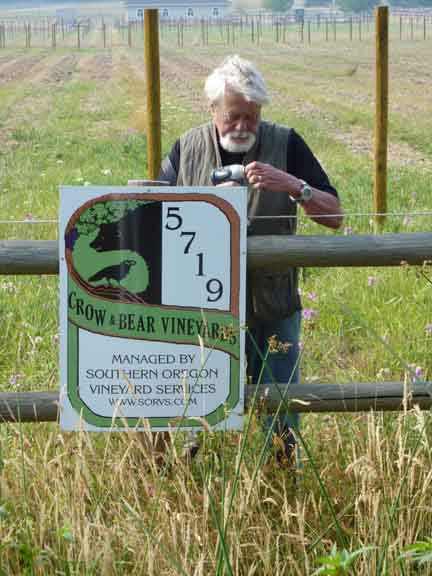
Taking down the sign. It's going back to the sign-maker for a little adjustment.
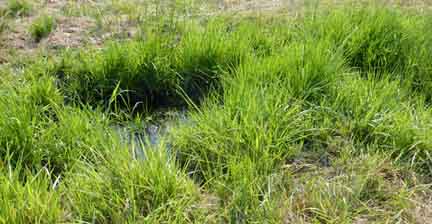
Our vineyard is now being managed by Michael McAuley Wines, with whose services we are well content. No others need apply. Saturday, August 10. An early morning meeting with Michael sets the new direction for our enterprise. First, we will complete installation of wooden end poles where it is appropriate that poles be. Poles in inappropriate places (such as straddling what is clearly, at present, a swamp) will be removed.
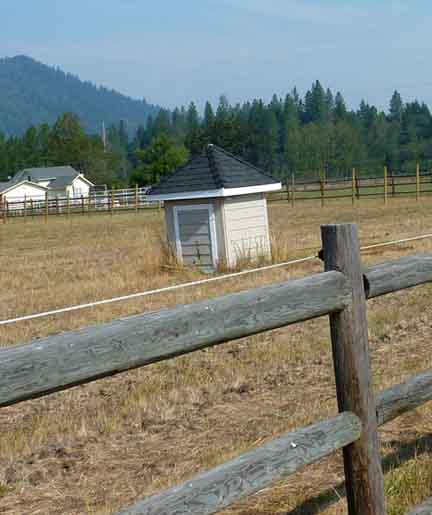
The swamp will be dug out to provide a large pond. The area surrounding the pond will be attractively landscaped. The remainder of the north end of that part of the west field we will consider leasing out to someone interested in growing produce for Farmer's Market. Poles in the west field will be placed so as to block off the well house to allow future access for any heavy equipment that may be needed to service the well. Though this will mean dead-ending five vine rows, it's an important strategy.
We have hired a small crew from Alexander Gardens to complete installation of those poles left unplanted. Michael has been busy spray-painting field marks.
Josh Alexander arrives, bringing with him a helper named Freedom.
How apt a name for today, as we truly, for the first time, take over the reins of our own venture. The previous strategy for filling post holes was (1) add half a sack of concrete, (2) add water. Michael has a different strategy: (1) add an entire 60-pound sack of dry concrete, (2) tamp down thoroughly, (3) add soil on what space remains on top, and (4) let the rains finish the job. Michael finds that this adds more strength and stability to the finished product. Steel anchors remain to be set, one to each post. We will defer that operation until rains have softened the soil.
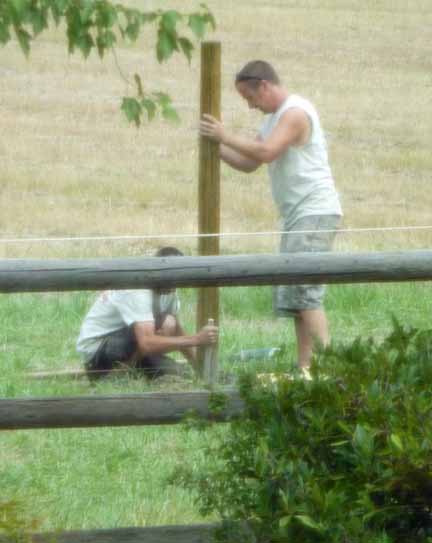
These men from Alexander Gardens are sharp. Michael explains to them that the wooden end poles must be set five degrees off true vertical, to resist the pull of the future trellises. Josh Alexander whips out his I-Phone, dials up an app that contains an inclinometer, holds the phone against the pole, and, as my British-born mom would say, "Bob's yer uncle!"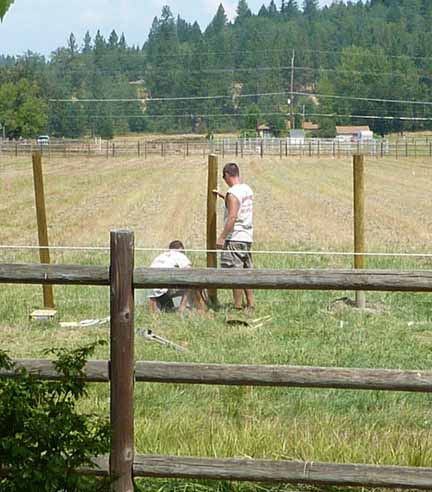
They will be back Sunday morning to finish planting the wooden end poles. A decision was taken to not attempt to drive any more of the steel line posts until the heavens have opened and softened the soil, which means late October, early November. This evening Matt relates another difference in operating style: He had loaned previous workers his big, heavy, digging bar. Today he stumbled over it way out in the west field. He brought it in and handed it to one of the Alexander men. "Here, can you use this?" he asked. They used it for a few holes, then found a better way, so instead of leaving it lying on the ground to be lost, they immediately stabbed it down into the soil, to be remembered and taken to shelter on their next trip in. We are well pleased. Monday, August 12. Yesterday our server was down, but the men from Alexander Gardens were not. As promised, exactly as promised, they came and finished the job, even though it was Sunday. What a joy to deal with professionals. More professionals are expected today: the excavator is due to scoop out the existing pond and build us a second one. I've got the camera's battery fully charged and rarin' to go. See you over at Chapter 2: Irrigation. * * * Tuesday, November 5 Remember the saga of the metal line posts and the hard, hard ground? Well, there's been a sprinkling of rain—not enough to soften the soil much— and there's been all that true ripping, all that real rototilling, and finishing to grade, (see Chapter Four: Cultivation) but that only went eighteen inches down, nowhere near as far as the metal line posts must be sunk. Yet today we have four full lines of metal posts in the first block of the east field, and those four lines stand ready to receive the first tiers of wires. How was this possible?
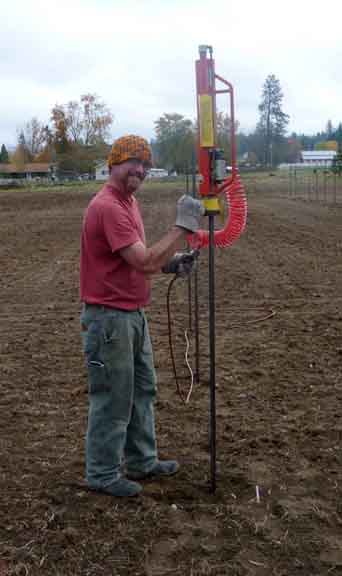
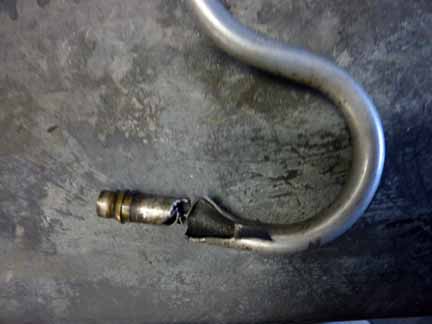
That, my dears, is the solution to the hard soil: a pneumatic post pounder, powered by an air compressor trundled around in Matt's little John Deere lawnmower/tractor. Matt found it on Craigslist, where the ad said it could pound T-posts. Reasoning that if it could pound T-posts, it could do the job on line posts, Matt bought it from the pawn shop that had placed the ad. Now, all by itself, the pneumatic T-post pounder wouldn't have fit the ends of our metal line posts, but Matt, clever amateur machinist that he is, milled and shaped a fitting for the bottom of the machine. If you look closely, you'll see it right there at the business end of the pneumatic pounder, just above the yellow ring at the bottom. And that is the difference the right equipment and the right mind-set can make. Five days of heavy pounding, of diligent use of the air compressor, and then suddenly blowout!
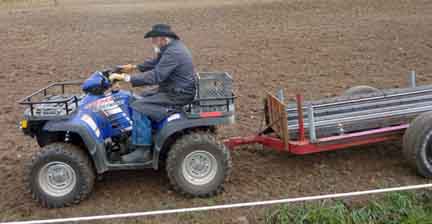
Fortunately, Michael was standing thirty feet away when it blew. Matt disassembled the whole apparatus and found a lot of crud, a lot of rust attributable to years of slipshod maintenance. He has diagnosed a faulty unloader valve, which he has sent for but not yet received, so post-pounding is stalled. Doesn't mean he can't pony posts out to their ultimate destinations. There he goes with a load: two hundred at a time, on the little trailer Roy and Rod welded up and left him, along with the Polaris he's pulling with.
The Polaris is a much more seemly steed. He just may buy it from Roy. February 23, 2014 The Polaris became Matt's Christmas gift. "No more clothes," said he, so I went with something I KNEW he wanted. He calls it his Zipper because now he zips around the ranch in style. Nor is he the only one to do so. Grandson Joshua, all of 13, took to it like second nature. And we put him to work, too. Matt, John, and Joshua, three generations of Morehouse men, worked out a rhythm to pneumatically pound those posts. It was a three-man job, and that third man, young Joshua, definitely pulled his weight. For two and a half full days of field work.
Halfway through the second day, Josh showed up at the door, crestfallen. "The pounder broke," he said. And he thought that meant the end of work. But silver fox Matt is an amateur machinist and an all-around handy man, remember? Into the shop they went, where grandfather disassembled the pounder, grandson watched as the broken O-ring was replaced and five more new O-rings were installed, for good measure. Less than an hour later the Morehouse Men were back at it. And that's why every farm needs a good machine shop. * * * But it was still the end of January, with typically unsettled weather— so when a little wind piped up (not severe enough to bring the men in) we knew anything could happen. And did. Came a sudden WHOOOOOOSH! "Wha...?" Oh My God, Look At That! The neighbor's loafing shed was blown off its tentative moorings, lifted like a huge steel balloon, and set down across the fence, right in our field.
When the wind abated, I went out with the camera but search as I might, I found no ruby slippers. Newest Posting March 25, 2014 Matt and Michael, having surveyed the fields and each other, decided that it was time to call in the reserves. We are NOT in a mood to let soft soil pass us by this year, as it was allowed to do last year. The time to pound the rest of those metal line posts is NOW. Herb Quady sent a hard-working crew . . .
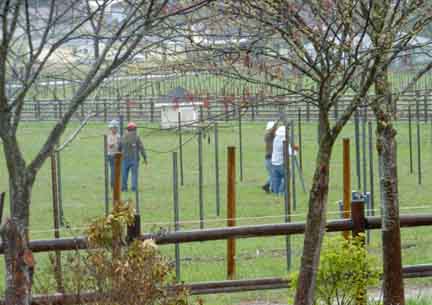
. . . that in the past two days have set rank and file marching across both east and west fields.
We are now masters of our own fate — with a little help from our friends.
Chapter Two: Irrigation Chapter Three: The Winery Chapter Four: Cultivation Chapter Five: The Vines Home