THE BIRTH OF A VINEYARD
Chapter Five: The Vines Chapter One: Poles and Posts Chapter Two: Irrigation Chapter Three: The Winery Chapter Four: Cultivation Home Go to newest posting All else -- the ripping, tilling, cultivation, the layout of poles and posts, the installation of sub-mains, risers, drip lines -- all else has been preparation. The vines are the main event. Ours arrive from Duarte Nursery in California. Matt helps offload the big truck.
Grandson Josh lends a hand.
Cartons loaded with 4-inch pots are stowed in the shade.
Safely corraled from bunny or deer, vines are sectioned by varietal. These are Tempranillo.
Michael is impressed with the quality of these Duarte vines. Some of the Durif (Petite Syrah) even bear small grapes already.
June 12, 2014 At last, at long, long last, planting day arrives. This is what we have been working toward all this long, tiring time. Matt, John, and Joshua (father, son, and grandson) lay out each green potted vine beside its pre-positioned bamboo training stake.
The job now is to keep ahead of the planting crew.
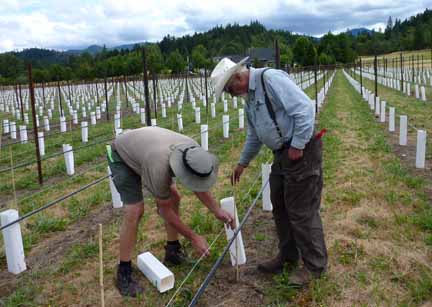
The crew, ten women and eleven men, dig holes for each vine. "Norte," says Michael ("North"), observing one hole being erroneously begun to the south of the bamboo stake. "Aha," says the field worker, and corrects the error. The crew moves forward like a dense, multicolored wave.
Next I see, all workers are on their knees, tucking the vines in their final growing spots.
Newly planted vines are vulnerable to predation. Rabbit, deer will freely graze if given half a chance. So light cardboard sleeves (referred to as "milk cartons" or "bunny boxes") now go over each planted vine.
(Matt, in one of his whimsical moods, fantasized this dialogue: "What's that you're growing there in those white containers?" "Milkweed. Soon as the cartons are full of milk, they fall off and we sell 'em in the market.") Speaking of deer, we have had to secure the perimeter of the Crow and Bear against their intrusion. Deer seek out the tender leading shoots of grape vines and can devastate a new vineyard. After all the work, after all the expense, we are not about to let Bambi destroy our investment.
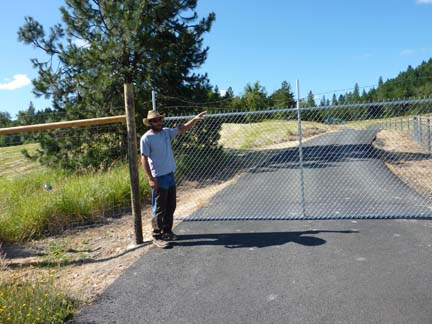
Automatically-opening gates with motion sensors will greet visitors but exclude marauding deer. Tim, with Caveman Fence, shows us the gate at the south end of our property.
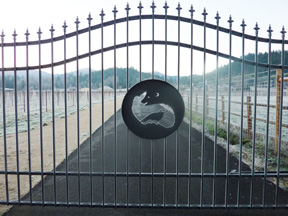
When it comes back from the powder-coaters, a handsome wrought iron gate complete with Crow and Bear logo will grace our entrance. June 14, 2014 First light illuminates rank and file, column and oblique, proudly standing-to, garbed in white.
At each station remains a small black plastic planting pot, the detritus of yesterday's work. The Morehouse crew turns out early for the clean-up.
Sherri Morehouse carries her stack of pots to the tractor head, where John will collect it with the other stacks.
June 18, 2014 Our new front gate arrives. Caveman Fence has gone beyond the call of duty; Randy Smith had our logo cut in steel and powdercoated. We are so pleased, we ask Randy, Mark, and Roger to pose for a photo-op.
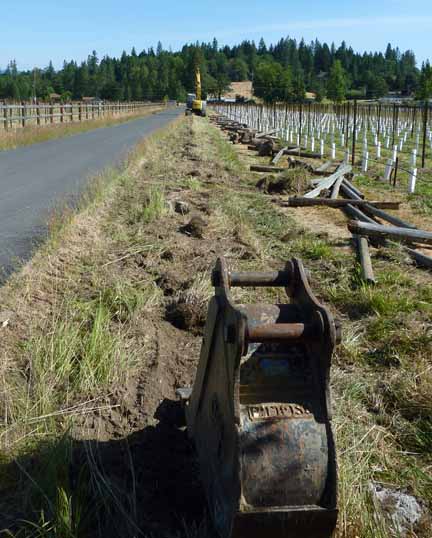
June 23, 2014 What was once horse territory is now vineyard. Low fencing flanking a narrow road is no longer needed. So if you want heavy work done, who ya gonna call? Roy Burns, of course. Matt directs the operation on the east side of the road.
With screech and clang, Roy's great beast lumbers forward, plucking an entire fence section at a time.
Behind him soon stretches a road's worth of detritus.
All those posts would be scrap but for Marion Knight's coming forward. "We're planning to build more fencing for our horses," she says. So who's Roy gonna call for the haul-away? His son, Rod, of course.
Excavator and dump truck, father and son, team in a finely choreographed pas de deux.
Sixteen dump truck loads of D.G. (decomposed granite) later, we have two lanes where there had been one. Lowering skies promise rain, so Roy and Rod decide to let Nature water it down.
Meanwhile, our tender vines, the center of all this show, have begun to take hold. Leaves peek above sleeves; tendrils grasp bamboo training stakes, reminding me of an infant's clutching his mother's finger.
Not by chance, not by oversight did I use the masculine pronoun. Michael tells me that tendrils are nonfruiting variants of the same structure. Some research online, and I learn that the vine's genetic code determines whether tendril or grape-bearing stem is produced. I think of a human infant, whose gender is determined by conjunction of X or Y. No surprise, then, that grapevines are hermaphroditic. Notice: In keeping with the swing of this whole northern hemisphere, that double-branched tendril is coiling counter-clockwise. June 26, 2014 Michael, excited, upbeat, invites us to tour the vineyard. "Shall I bring parasol, or umbrella?" I ask. "Both," he answers, for this is Oregon and given to change at any moment. From vine after vine he lifts the "milk carton" to show us new growth: in many cases, six inches of foliage in the past two weeks. Even some damaged stock that had been thought dead is responding, pushing new buds. Those few that he deems beyond salvage, candidates for replacement, he flags with green tape visible from afar. Find the flag.
Tape in one pocket, pruning clippers in another, Michael introduces Matt to our thriving Tempranillo.
July 11, 2014 Returning from a week's required absence, we learn of deer damage. Michael shows us where an intruder has nibbled back the leading shoot. Just where it's tenderest and apparently tastiest, right above where the buds have "pushed" in their reach to be a vine, a deer has permanently thwarted that direction of growth.
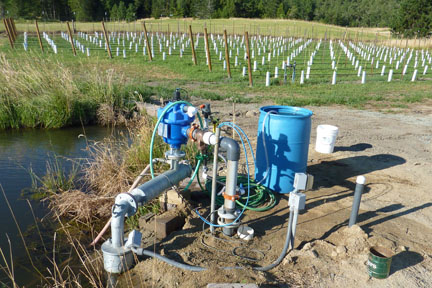
True, the plant has not been totally killed, for foliage remains, but it will be difficult now to train this plant to be a vine rather than a bush. A strong trunk is what a vineyardist is after. Opportunist Bambi has challenged that destiny for this plant. City folks may be charmed by the idea of a deer in the backyard, but to a wine grower, they're an enemy, a kidnapper in the nursery. July 11, 2014 All day we have been fertigating. Precise, premeasured amounts of fertilizer are delivered by drip to each little patient. After dinner Matt heads out to tend to the system, shutting off one block for the night. Moments later he rushes back in his Polaris. "Where's the camera?" he ssks excitedly. "The sun is shining through the DrippleOptics." He thought you'd like to see it, too.
Now, this [the tall blue thing on the right] is the tank where the fertilizer lives, in dilute solution (no, no, the small blue thing on the left is the filter). This is the hose that comes out of the tank [on the right] where the fertilizer lives, in dilute solution. This is the Venturi [look it up; it's Italian] that connects to the hose that comes out of the tank [on the right] where the fertilizer lives, in dilute solution. This is the supply line that leads from the Venturi that determines the mix and connects to the hose that comes out of the tank [on the right] where the fertilizer lives, in dilute solution. These are the vines that receive the precise mix delivered by the supply line that leads from the Venturi that determines the mix and connects to the hose that comes out of the tank [on the right] where the fertilizer lives, in dilute solution. This is the money that's saved by the precision delivered by the supply line that . . . you get the drift.
Newest Posting August 11, 2014 Fertigating again, and the vines are loving it. Some are taller than we are.But all that lush growth doesn't get to stay. It's a summertime energy factory for the trunk and roots. Come autumn and all that exuberant greenery will get cut back to just two buds, above the graft. Among the rows the prunings will lie, to be mowed into mulch. But for now . . . for now, reach for the sky, little green things. Reach for the sky.
Chapter One: Poles and Posts Chapter Two: Irrigation Chapter Three: The Winery Chapter Four: Cultivation Home