THE BIRTH OF A VINEYARD
Chapter Three: The Winery Chapter One: Poles and Posts Chapter Two: Irrigation Chapter Four: Cultivation Chapter Five: The Vines Home Go to newest posting Inside what had been a horse barn, three horse stalls have been removed to provide room for the wine production room and a public ADA bathroom.
The tack room will become the new tasting room. (Matt's cannon will live elsewhere.) We're putting in a window so visitors can see into the barrel room.
Taking a sight for the excavator.
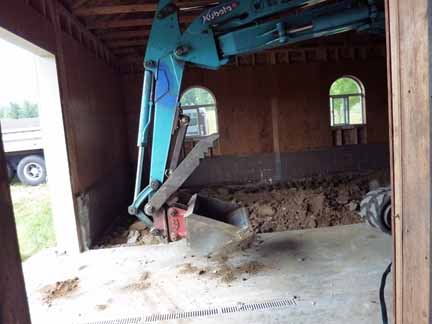
May 23. A small excavator, but it sure looks big inside the barn.
Taking a bite out of the dirt floor.
Dig-out complete, forms follow in the production room, ADA bathroom to occupy the far end.
May 29. Here comes the concrete truck. It's a tight squeeze backing in that driveway.
Pouring concrete in the production room.
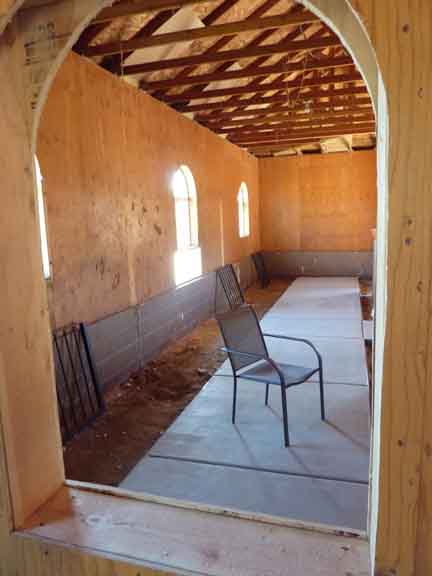
Opposite the production room is the barrel room. Barrels will go there.
Concrete walkway all poured and beginning to cure. Later, the dirt is going to have to be dug out on either side to accommodate the barrels.
Welcome, Michael McAuley, resident winemaker.
Adding vents to the roof of the winery. How's the view from up there?
Framing in the bathroom. More sticks to come.
Indoors, the bathroom is now framed in.
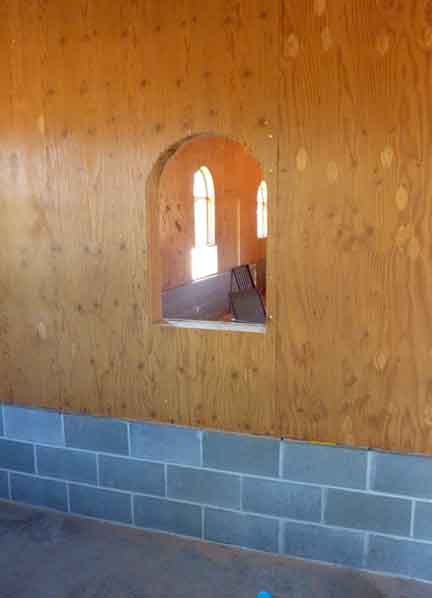
We've cut a hole for a window in the to-be-tasting-room wall so visitors can see into the barrel room.
Another hole, this one awaiting the cooling system for the barrel room.
Matt figures that barrel room is going to be a nice, cool place to sit on a hot day. He's ready.
Matt, what are you doing with a pick and shovel? On a Sunday? In the heat of mid-day?
"Rock" me, baby.
A barrel room requires a temperature of 60º and high humidity. The air conditioner we'd planned isn't going to work, so we've decided to try a swamp cooler.
Winemaker Michael plans his tasting room layout with a chalk drawing on the floor.
Matt peers into the barrel room. Visitors will have the same view.
The swamp cooler in place.
Three sliding doors once held wrought iron grilles, but the barrel room needs to be a closed environment, so plywood panels replace the grilles.
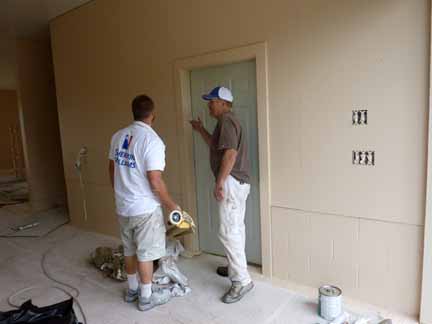
The winery is now ready for painting. First, the primer. It will end up taking three coats to cover the legacy of this building's having once been a horse barn.
After the priming comes the caulking.
The color coat is on. It's warm and inviting, a perfect foil for wood, concrete, and light fixtures soon to follow. The door to Michael's laboratory will remain white.
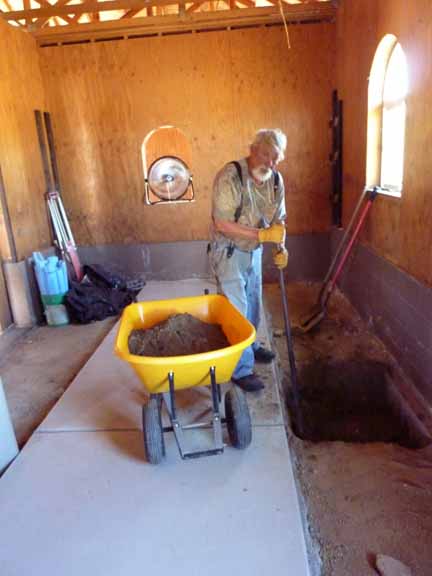
The barrels will go on either side of the concrete walkway, but first the very hard-packed soil has to be removed. It takes a jackhammer to break it up. Michael McAuley, winemaker, puts in sweat equity.
Matt mans the shovel.
The jackhammer-and-shovel operation as seen through the window looking into the barrel room (a bit of an optical illusion).
The light fixtures are in and looking good in the production room . . .
. . . the tasting room
. . . and the barrel room. That's Matt peeking at us from the tasting room.
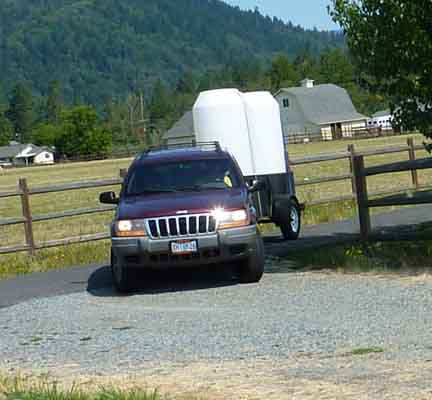
July 1. Michael McAuley drives in with two tanks for the production room.
Ten yards of river rock must be spread in the barrel room. Matt hires man and machine from Alexander Gardens to help with the task.
Our elder son, John, helps shovel rock. He's on stateside leave from Matson Navigation, but he's working hard. Our daughter-in-law Sherri also shovels hard, though the camera missed her.
Matt rakes rocks.
The rocks are hot from their time in the sun, so now that they're in place, we need to cool them down.
July 2. Michael McAuley was busy yesterday, transporting tanks, kegs, and a couple of barrels to the production room. Raul, irrigation specialist for Willamette Valley Vineyard Services, takes a cool break and checks it out. [Later we learn that Raul has been stricken with a serious malady and has been taken to hospital. He must have been struggling even now. He has our prayers.]
Michael arrives again today, bringing boxes of empty bottles . . .
. . . a wine press . . .
. . . and a crusher/stemmer.
He shows us the bottom of the crusher, where the detritus exits.
July 3. An early morning visit (it's getting hot now) shows the production room looking just about ready for business.
In the ADA bathroom, two basic fixtures have been installed.
Michael has brought his table saw, in anticipation of working on furnishings for the tasting room. This is a winemaker of many talents.
The ADA-compliant bathroom has received grab bars.
Matt monitors temperatures in the barrel room, where the goal is a consistent ambient temperature in the very low sixties.
Michael delivers two primary fermentation vats to the winery. Each vat is capable of holding a ton of grapes.
Monday, July 22. The winery holds a surprise. Though a Porta-Potty was promised for the field workers, none has been delivered. The winery bathroom is not yet hooked up to septic services, but somebody didn't know that. Oops. We have had to lock the door to the bathroom until it is fully functional.
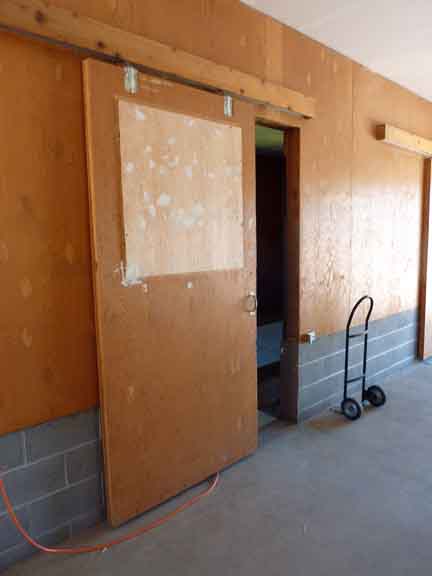
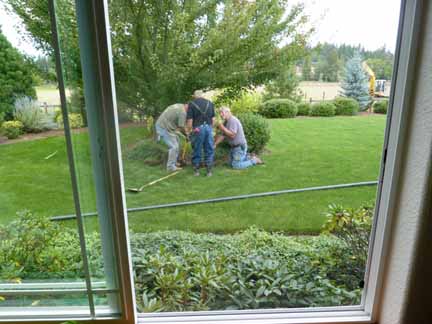
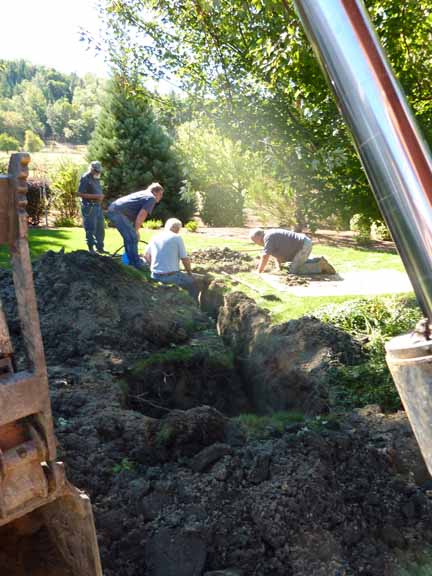
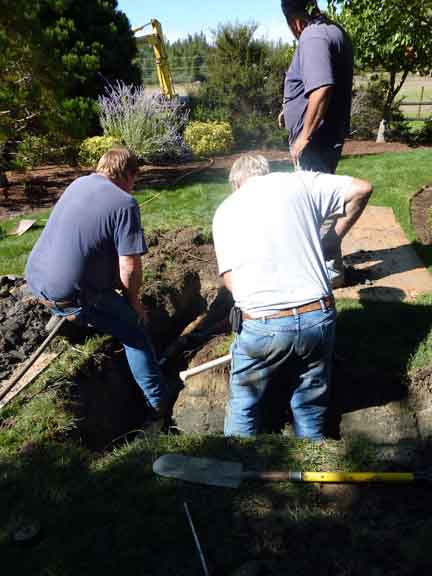
Speaking of doors, the winery needs a good front door. We've decided to keep the original sliding barn doors, but use them as shutters. We're having a handsome pair of lockable front doors, to fit inside those "shutter doors," custom made by Tim Hansford, who did much of the cabinetry inside our home. They soon should be ready to make their debut. Michael saw them today and liked them well enough that he's going to design his tasting room counters to complement or match. I asked Matt what they looked like, and he said, "Medieval." That doesn't surprise me. You see, we have repurposed the beams and boards from a most impressive, solidly built pergola, a handsome enough construction, but in the wrong place for me, because it felt like (and I had been heard to call it) a big, bushy eyebrow occluding all view beyond. Matt, honoring my claustrophobia, had torn it down (for he loves me, he truly loves me) but all the lumber he had saved. Part of it went to build the wall to his shop, part became a work bench, part holds his shop wood stove. Enough remained for Tim to fashion a massive pair of entry doors for the winery. Strap hinges, three to each side (for this is A Heavy Door) will look good, we think (as long as they're real strap hinges— no fake anything need apply). I'm eager to see the finished product. As soon as I do, you will. Sunday, September 8. Remember that spacious ADA-compliant bathroom we've installed in the winery? The bathroom that no one can use yet because it's not hooked up? That has been the single most complicated part of this whole endeavor. Who'd have thought? It seemed simple enough to plumb to the outside of the building, and a septic system specialist we called in said yes, we could put a septic tank right there, to the south and slightly in front. But the Powers That Be said no. No. Definitely no. Something about building inspectors or drain fields or it was such a hassle I forget what. But. Someone suggested an injector system, which in principle seems simple: collect the waste in a holding tank, pump it into our house's (fortunately) two-chambered septic tank with its effluent filter, and from there let our house system send it back down the driveway to the sand filter, to the south of the winery. Basically, pump stuff up to the top of the hill and then pump it down again. Trouble is, our house is about five hundred feet from our winery. And there's a lot of road and a lot more lawn in between. This is where it gets tricky. Remember, back in "Chapter Two: Irrigation", the culvert Matt and Roy had to thread the pipe, the locator line, and the data line through? That was the pipe. Remember the trench going from the culvert across the field in front of the house? So far, so good. Here's where tricky starts. Matt, Roy, and Rod try to locate the waste line from house to septic tank.
Little hole turns into big hole turns into trench. There goes the lawn.
Uh-oh. Trench we've got to connect with is way over there beyond the lovely shrubs, bushes, and trees, across all that nice lawn. What to do? Roy knows. Call in Steve Colton (Roy says, "He's saved my bacon more than once") with his hole hog. The Mole.
Steve takes a good sighting, sets the business end of The Mole in place, hooks up the pneumatic pump, and thud-thud-thud-thud-thud like a giant's heartbeat the hole hog makes its noisy, subterranean way toward its goal. Rod watches progress from the receiving end.
The Mole comes closer. Thud-thud-thud-thud I can feel it underfoot. Then Rod calls, "Wow, look at all the worms getting out of the way!" Saturday, September 21. Back to the doors: Upon taking possession of this property we have dubbed The Crow and Bear, our very first project was the deconstruction of a massive, beautifully built pergola that stood just beyond our south-facing patio. Its posts and beams have been repurposed in several ways, the most visible being our new winery doors. "How do they look?" I'd asked Matt after his visit to Tim's place. "Medieval," he'd replied. So with that in mind, I asked Matthew Miller, of ironhardware.com to fashion us six hand-hammered hinges, in a straightforward, clean-lined design, finished with Paso Robles Ironworks' iron oxide patina.
Now that hinges and handle set have arrived, it's time to put the winery doors in their frames. Cabinetmaker Tim Hansford and his helper Clay Robinson lift the massive doors onto sawhorses for processing.
The doors are finally in place. We kept the barn's original sliding doors to act as shutters.
We can hardly wait to open for business. October. We are crushed. Eager to establish our label, we have purchased a ton of fine Syrah grapes, which Michael has agreed to process into wine for the Crow and Bear. This should, of course, be happening AT the Crow and Bear. But The Other Powers That Be are telling us no, we cannot use this fine facility as a winery unless and until we have fifteen contiguous acres producing wine grapes. Well, shucks, our vines won't be in the ground until next June. Production of grapes won't come along for three years. We are, naturally, upset. But not defeated. Michael, after all, is a bonded winemaker. His home, in the City of Grants Pass, has a 250-square-foot garage that is licensed as a winery. (Does it strike anyone as strange that The Other Powers That Be have no problem with a winery in the city, but have stringent restrictions upon one in agricultural land in the county?) So Michael has most graciously agreed to undertake for us a custom crush, which we are following with keen interest.
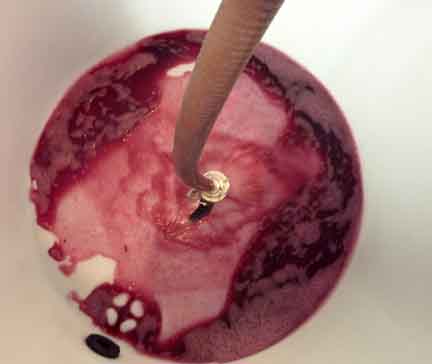
We missed getting to watch the actual crushing of the grapes, but their aroma is now wafting from the primary fermentation vat at Michael's abode. We pay our new wine a visit, just in time to see the pump nozzle inserted into the vat . . .
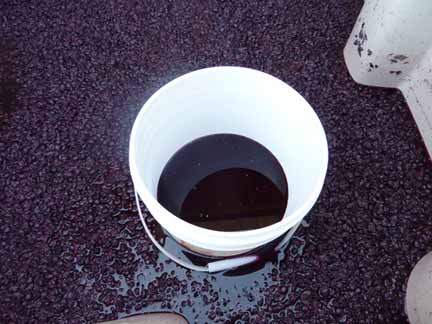
. . . the improvised colander (a bucket with holes punched in it, to filter out the grape skins) sunk into the aromatic liquid . . .
. . . the new wine coming through the hose into the collecting vat . . .
. . . and Michael stirring the colander's contents with— yes, that's a canoe oar.
It's time to taste the very first of this vintage, for though more processing remains, it is, at this very moment, already wine. Michael plays the Wine Thief.
The vintage is bracing. Full of promise. Michael brings us the pressing's residue, a barrow full of pomace.
He explains that pomace is a fine soil additive for acid-loving plants such as rhododendron, azalea, and the like. Matt as ever, thinking outside the box, tries adding water and reducing the pomace to a sauce. He tries it over vanilla ice cream and pronounces it delicious.
Hmmm . . . he may be onto something. Nothing of that pomace has gone to waste: the neighbor's cattle now come running when they see us with a bucketful. Days later, they return to the spot where the leavings fell, hoping that more may have sprung from the aroma, all that remains of the pressings of our fine Syrah.
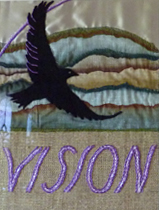
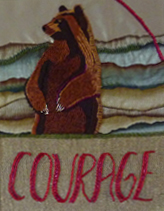
Meanwhile, we are told by an agent of The Other Powers That Be that whereas we may not, yet, use our winery for the making of wine, we may, paradoxically, use it for the storing of wine. And whereas we may not, yet, open a tasting room, we may, paradoxically, hold "special events" at the Crow and Bear. These events would include the pouring and selling of wine, we have to imagine. As the inimitable Red Skelton used to say, "I don't explain 'em; I just do 'em." Or, in other words, "Que Syrah, Syrah." Still October The Syrah, now in its secondary fermentation (yes, at Michael's city facility, not yet at its proper home at the Crow and Bear), will be bottled and labeled as our first release of Courage. Vision, our first white, will be a fine Marsanne, picked at its penultimate moment of ripeness.
Michael explains that the goal is not to change the grape, but to try to put the fruit in the bottle.
To that end, he loads our Marsanne into the press whole-cluster, which, he says, gives a higher quality juice than would be obtained by crushing and destemming.
After the first fraction, he opens the "cake" (to make room for more fruit) and reloads for the second pressing.
We'll end up with 86 or 87 gallons of Vision, which is now in its primary fermentation. If the wine fulfills the promise of the juice (the "must"), we will be pleased, indeed.
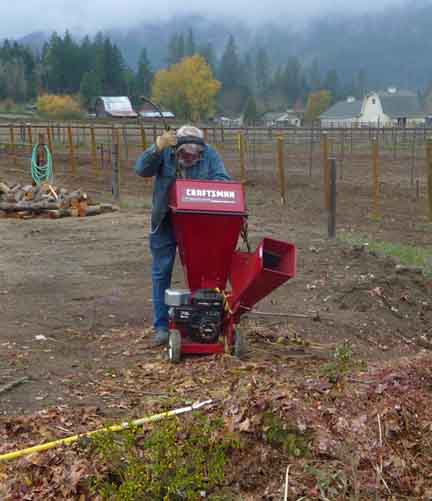
Tuesday, November 5 The winery is busy front, back, and inside. Out back, Matt feeds yard detritus into a shredder to add to the growing compost pile.
That's Michael, prone and delving into the small trench that will take electric power to the planned outbuilding, future home of all our farm equipment.
Out front, Roy uses a vibrating roller to smooth down the parking lot he'd graded for us.
It's a thrill to see the winery begin to look like an actual place of business. Remember the Syrah that Michael pressed and vinted for us at his bonded facility in the City of Grants Pass? Michael had a chance to acquire four barrels of fine Merlot from RoxyAnn Winery, which he will bottle for us under our own label, as soon as we receive our final permitting. Michael, at his bonded city facility, will add some of our new Syrah to create our first red blend, Courage.
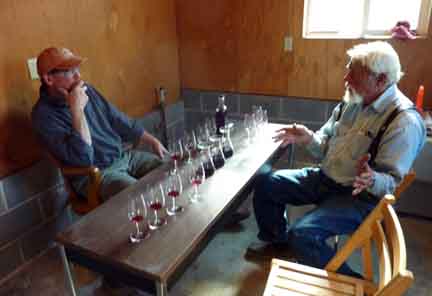
He invites us into his office for a taste testing: should it be the straight Merlot, a 2.5% Syrah blend, or a 5% Syrah blend?
We're on our way. * * * I feel like Dorothy of Kansas, emerging from the travails of the yellow brick road and standing before the gates of the Emerald City. A very significant one of the Other Powers That Be has accepted our application for a liquor license. After a personal interview in their office, two of This Power's representatives paid us a very prompt visit and left, as a token, tacked to the roadside aspect of an end pole, this sign:
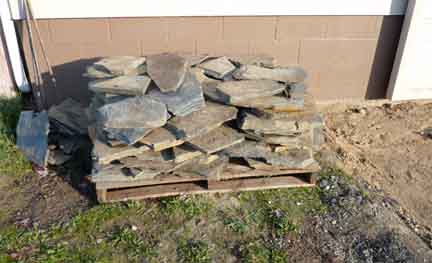
I know it's not over until we're pouring that first glass of wine in the tasting room, but for the first time in weeks, I feel hopeful. Tentatively joyous, even. Time to forge ahead and get the place ready for visitors. Michael and Barb will sell us this lovely slate for the entrance.
Roy cuts a pad to receive the slate.
Matt plants pampas on the berm out back. Its roots will prevent erosion; its plumes will give a lovely view.
Bring on the rains. * * * Rains we asked for; snow we got.
The Baron, wrapped in his black-powder-shooting kapote, surveys our winter wonderland. "And what will the robin do then, poor thing?"
The winery stands shuttered.
The pond wears ice—not thick enough to skate upon (the road sends a careless walker skating)— yet thick enough to discourage a duck. Nearby, the compost pile gently steams. 140º reads the thermometer. I wonder what small creatures are finding it a haven from the cold. All outdoor work stands suspended. Now is the time to finish that wall separating the tasting room from the production room. Matt began framing in the wall late last month. Not one to waste materials, he salvaged wood from the horse barn. Look closely and you'll see signs of "cribbing" on those studs.
Working alone, he got the paneling just about finished.
Soon, Michael and Matt (this will be a two-man job) will install the door salvaged from a horse stall, still bearing its handsome wrought iron grate.
The tasting room will follow. With the wall installed, a space heater can take off the worst of the chill. Now is the time to work indoors, finishing the tasting room. January 22, 2014 After Christmas, Jim and Lisa come to visit, bringing with them their two lovely daughters and a beautiful gift evoking the Crow and Bear in yet another medium: stained glass.
Michael will build a shadow box and light it from behind to house this treasure in the winery. Out front, something new has been added. Josephine County, as one condition for our permitting, asks us to widen the driveway where it meets Jerome Prairie Road. Who ya gonna call? Roy, of course. And this time he brings his cousin, Doug.
Men and machines, they not only widen the driveway, but they also move—intact!—two stone cairns that had stood imposingly on either side of the driveway for longer than anyone around here can remember. Remarkably, the cairns don't break apart. Roy attributes their stolidity to their most-likely manufacture by Mexican stoneworkers, who use a technique whereby the stone facings are not glued onto the concrete core, but rather, are mortared in place to form a box into which the concrete is cast. In any event, here one comes, to grace the front of the winery.
Doug works the excavator, while Roy and Matt guide the cairn's placement. Both cairns in place. They will receive crafted placards identifying on the left, Winery, on the right, Tasting.
And what else is new?
On the left, Roy is selling us his flatbed diesel truck, a vineyard necessity. On the right, Matt has had Cleary Construction build us a steel pole barn that will become our warehouse for all non-winery-related equipment. March 23, 2014 This month we received a very special addition to the tasting room. In keeping with the fine craftsmanship evident throughout, Jim Morehouse created for our bar one of his beautiful concrete countertops. It took six men to carry it in the door.
Settled and shoved into place, that puppy ain't goin' nowhere.
Another artistic addition: For Valentine's Day, I spirited Matt away for an overnight. In our absence, Michael and Roy transported the mascot of the place to surprise Matt upon our return. There he stands, in life-size bronze, Old Growler himself. When you visit, be sure to rub his nose for luck. Notice how many hands have already done so: his nose is turning golden.
The sliding door with the wrought iron grille is in place. It allows visitors to peek into the production room while restraining their entry.
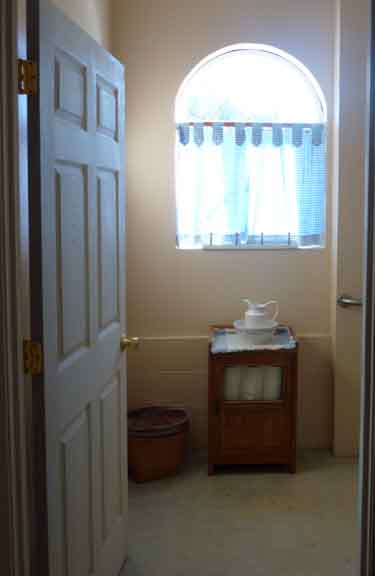
And the bathroom now has curtains, a small dresser, a pitcher and bowl . . . those little touches that make a place feel homey.
That's what you can see of our changes to date. But as with most things, it's the invisible that's most important. Permissions. Since last September we have been awash in a governmental alphabet soup. Last week alone saw us sending the TTB bond to the OLCC, who now needs our LLI while we wait for the DEQ to send yet another inspector. Whew! The good news is that (cross your fingers, friends) if all goes well and the OLCC receives our LLI, by next week we should finally get our ATO. ATO is the biggest biggie of all, the plum in the pudding, the brass ring on the merry-go-round, the key to the doors to the Emerald City: our AUTHORITY TO OPERATE! And that, my friends, deserves one of my rarely used exclamation points. Here, have another for good measure. ! April 25, 2014 And here, finally, it is: our Authority to Operate.
The "Privileges" are spelled out: "This license allows the licensee to import, bottle, produce, blend, store, transport and export wines, and allows wholesale sales to OLCC and licensees, and retail sales of malt beverages and wine for consumption on or off the licensed premises." Reading that, finally, is as big a thrill as finally seeing fruit on our vines will be. Now we have to get ready for our official opening. The entryway needs to be paved with fieldstones. Michael makes a good beginning.
Newest Posting August 12, 2014 Oregon Travel Experience got our blue informational road signs up earlier than we expected. Ready or not, here come the customers, so ready or not, here we are serving them. What a thrill! You see, all of this--the vineyard, the winery, the tasting room-- has been exhilirating, but oh my, it's been a struggle. Weather, plants, animals, insects, work schedules . . . farmers have hassles with them all. Just keeping deer out of the vineyard is a struggle. But visitors to the winery, that's communion. We welcome each individual, each couple, each group joyously. And we try our best to make them comfortable. The other day I conversed with two ladies enjoying a glass of our wine as they stood outdoors, in the shade of a maple tree. "Tomorrow you'll have a picnic bench," I promised them. Making good on our word, Matt got out some plans, some scrap lumber, and his tools. Two trips to the hardware store and he had a hand-crafted bench assembled. Here he's bullnosing it to take off the rough edges.A mover's dolly helps us get it down to the winery, where it now stands, inviting visitors to enjoy the good weather and the good view.
Y'all come. August 24, 2014 And come they did. Here's Rita, Joanne, and Carolyn enjoying a picnic lunch and a bottle of wine.
"So beautiful and cool under that tree," says Rita. "We'll be back often," says Joanne. "You are so very welcome," say I. August 26 2014 Construction has begun on the stamped-concrete patio planned for the front of the winery. Darrel Reum peers through the transit, establishing elevations to assure proper drainage.
Heavy equipment operating courtesy of Scott Rugh, who knows a thing or two about getting those slopes just right.
Bring on the concrete truck! August 29, 2014
And pour it did. Most excellently. Next came the smoothing.
A little rinsing, a little stamping, and we're back in business through the front door. Yay! August 30, 2014 Concrete patio is stamped and ready for traffic. Picnic tables afford al fresco seating, umbrellas (one so new it's still wearing a price tag) offer shade. Bring on the Grand Opening!
September 1, 2014 Matt thought he needed some moose milk to install a pebble mosaic I made for that cairn in front of the winery, but elder son, John, figured out a way to use materials at hand. Together they got the job done. Now it's my turn: with the plywood form free, I can build the mosaic for the other side, which will say "Tasting."
Chapter One: Poles and Posts Chapter Two: Irrigation Chapter Four: Cultivation Chapter Five: The Vines Home