THE BIRTH OF A VINEYARD
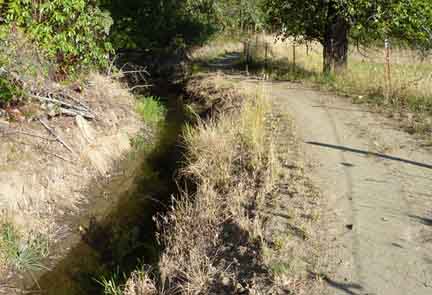
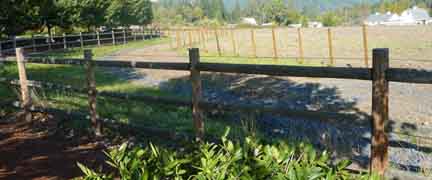
Chapter Two: Irrigation Chapter One: Poles and Posts Chapter Three: The Winery Chapter Four: Cultivation Chapter Five: The Vines Home Go to newest posting Monday, August 5, 2013. Any farming endeavor (and a vineyard is a farm, no doubt about it) lives or dies by water. You've seen our irrigation district's ditch (in Chapter One: Poles and Posts),
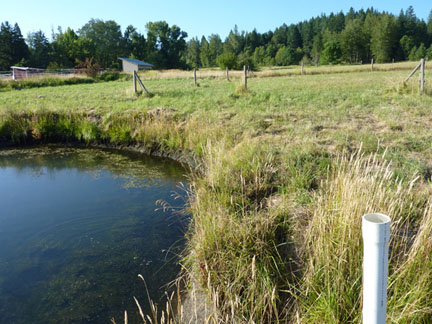
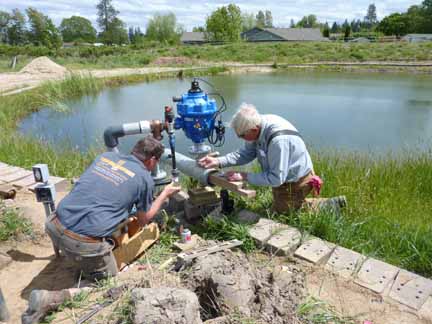
and you've heard about our ditch days, and you've seen the pond into which that water flows.
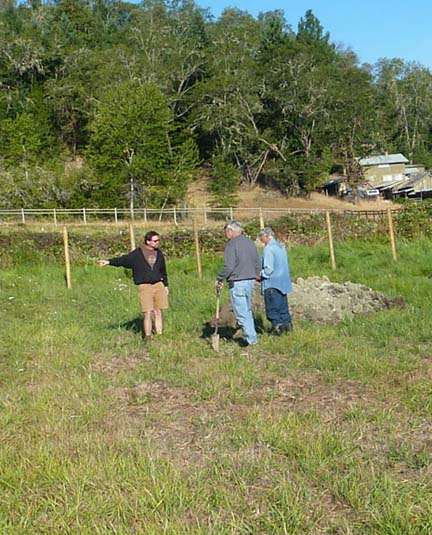
Now, we can't change the amount of water that comes into it, but we certainly can change the holding capacity of our pond, that pond behind the winery, in the southeast corner of our land. It will be our first step toward securing adequate water resources for the vines-to-be, for the vineyard now managed by Michael McAuley Wines. Today Matt arranged with an excavation company (the same company that years ago created our pond, in fact) to increase the depth and the area of that pond. Work begins next week. I shall be there with the camera. Tuesday, August 6. Today we walk into the end of the west field to survey the situation with the wooden end poles. Walking through umber fields, emerald seems to lie ahead.
We haven't put down irrigation pipe in this location, yet this entire area looks lushly, preternaturally green. From thirteen far western poles to their thirteen mates, all is strangely verdant.
And then we nearly step into a hole that holds . . . enough water to float a rubber duck.
The entire area to the east of the blackberry vines (always a plant indicator of abundant and persistent water), whether from a leaky ditch or from artesian sources, is a natural swale. Sherri had noticed it; so had John.
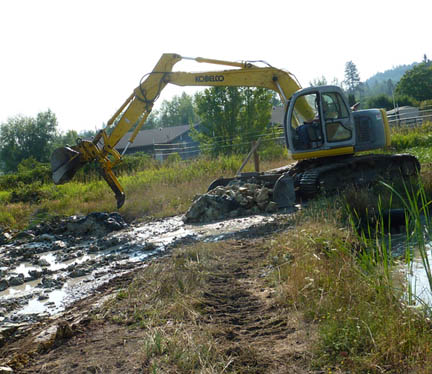
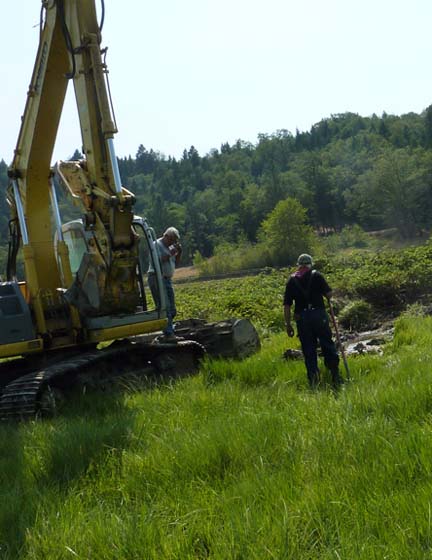
Seems to us that this area wants to be a pond. Just what we need, in fact: an independent, year-round source of water. Sherri and John were astute observers, and we shall pay them heed. Not being of a mind to let this project run athwart the gods a moment longer, we have decided to remove that set of thirteen end poles and their thirteen mates to the east of them (for grapes cannot abide a swamp, in any case) and call in the excavator to deepen what nature has here begun. We shall have two ponds. We can hardly wait! Wednesday, August 7. This afternoon Matt makes a closer inspection of the area where we foresee digging the new pond. There, on her own side of the natural blackberry barrier separating our properties, picking berries, stands our lovely neighbor Carol. "What's it like on your side?" asks Matt. "Dry ground over here," she replies. "Well, I'm standing in a swamp," says Matt. "I don't understand why they even planted these poles here. Look: the holes are full of water. We're going to have to rip out these poles when we bring in the excavator." And he tells her of our plans. "You can't fight Mother Nature," Carol says. "If it wants to be a swamp, let it be a pond." Our thoughts precisely. (Matt says those are the sweetest blackberries he's ever tasted. I can feel a cobbler coming on.) Monday, August 12. The excavator that was scheduled for today hadn't shown up by 0900, so Matt called its owner, who said he needed to finish up a prior job and maybe he'll be here tomorrow. (I am reminded of the old saw, "Don't call us; we'll call you." Sure wish they would.) Anyway, regarding that new pond we plan to dig in the swampy part of the west field, there's a concern about the precise location of the northern neighbor's buried-pipe access to The Ditch. We surely wouldn't want to bite into it with that big excavator. So Matt went seeking information. Neighbors to the south and west didn't know for sure. Potentially affected neighbor to the north didn't know for sure. Dave with the irrigation company suggested hiring a local dowser famed for his accuracy, but the dowser is out of town until next week. (Golly, I would love to have seen a good dowser, a legendary dowser, work!) But who did know was the previous owner of this property, and, most importantly, the man who once had lived in the property to the north and had installed the buried line, ten feet from the fence, behind our profusion of blackberries. We shall tread lightly in that area. Looks as if we're on course for a successful dig tomorrow. Maybe. Tuesday, August 13. [singing] "It's a good day for singing a song and it's a good day for moving along, Yes, it's a good day, how could anything go wrong?" [/singing] Yesterday was full of knots and tangles, one of those days where, inexplicably, everything goes wrong. Today promises to be clear sailing. Grants Pass air quality is in the green (good) rating this morning, for the first time since the forests began burning. The excavation is scheduled to begin at 0730; Dave Bower, from Ewing irrigation, is due at 0800; the camera is charged and so am I. Let the action begin. * * * You could hear it from the house, the thrum of the excavator's engine, the clang as it offloaded from the big flatbed. It draws me like a circus barker. Roy and Matt confer about today's plan. The existing pond will be deepened, then widened. Detritus will be dumped between pond and vineyard,then smoothed.
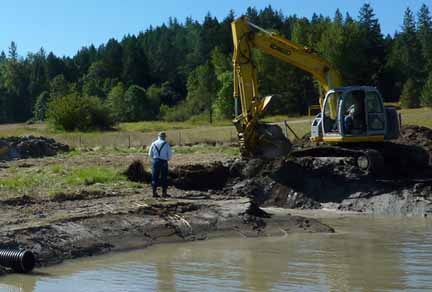
Roy climbs in the cab, fires her up, and action begins with a poof as bucket hits water.
The bucket sinks; air bubbles up. Like a diver, the bucket goes down and down.
Rod, Roy's son, ambles over. As we watch, mesmerized, Rod says, "He's good. Once, I watched him pick up a quarter with that bucket."
Roy brings her up, swings her around, and drops a load.
There's a lot of good clay in the first loads. Roy opines as how a local pottery shop would envy that stuff.
Earl, from Townsend Farms berry operation, drops by. We stand and palaver as work continues. "He's good," Earl says, nodding in busy Roy's direction. "I seen him throw a stick with that bucket, once. And I seen him bring up a bucket load, bring up another, bring up another and another, and finally roll 'em all together till he had a dump truck load. That Roy, he don't waste no time."
Yup. We've got the right man on the job.
* * * Several town errands later, I return to our excavation project to find the first pond, though temporarily clouded with mud, permanently and considerably wider and deeper.
To further enhance the pond's capacity, Matt has had Roy cut a trench from a purposeless ditch at the far east of our property (which has been servicing no one but has been channeling water to a roadside ditch to our north) to our existing pond, from which it will again make its way back to the purposeless ditch and on to the roadside channel. We will, of course, install a culvert in that trench.
Then it's time to clatter across the fields to the (hopeful) site of our new pond. Matt has Roy take a bite out of one of those wet spots in the swamp.
Surprisingly, this little trench reveals only a couple of feet of topsoil, and from there on, nothing but tombstone granite. Matt asks Roy to take another sample, closer to the blackberries.
Same shallow soil, same deep tombstone granite. Maybe over there, closer to the blackberries and closer to Larry's place?
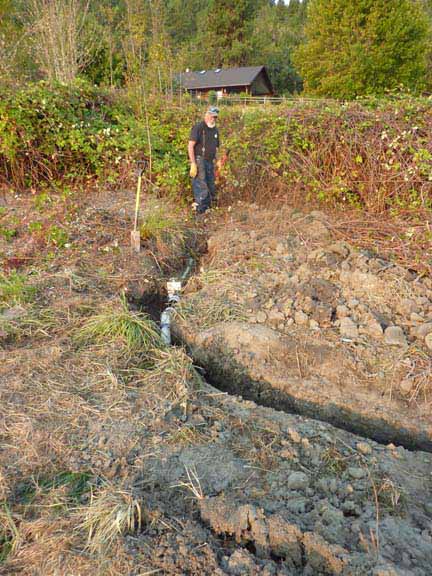
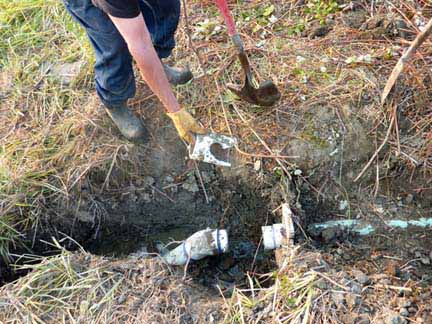
Nope. Water gushes in, as we'd hoped, but not the WAY we'd hoped. We've struck Larry's buried irrigation pipe. Roy immediately phones his son for some replacement PVC; Matt immediately heads uphill to turn off the ditch; I immediately scurry inside to phone Larry. OOPS. An hour later the damage has been repaired. An hour after that we have a surprise visit from OVS, Oregon Vineyard Services. Matt's in the kitchen. I answer the door and explain to the gentlemen that we've had a challenging day. "Hit a line, eh? Happens all the time. Good thing it wasn't gas." Wednesday, August 14. An early morning strategy session in the problematic far west field, that presently requires wading boots. Michael, Matt, and Roy confer.
Two possible strategies present: the first is a new ditch. The water seems to be coming from our uphill neighbor to the west. Roy suggests digging a V-trench to channel that overflow from the neighbor's flood-irrigated fields and take it safely to the north, which would allow us to grow grapes in what is now a swamp, and which would avoid a confrontation with the possible offender, but which would deliver to the neighbor to the north a large amount of runoff that is presently being absorbed into The Swamp. Matt still likes the second idea, a pond. Trouble is, yesterday's test holes showed topsoil to only three feet at most, and then a bottom of what Roy calls "tombstone granite." Matt sees this granite layer (which is who-knows-how-deep) as an advantage. He suggests waiting until The Ditch is turned off and runoff is no longer a problem, then pushing the topsoil from The Swamp to the southern part of the east field, which had originally been intended to receive Tempranillo grapes. Dig to a deep granite bottom, he envisions, and berm the sides if necessary. Michael and Roy allow as how that could work. So Matt directs Roy to dig another test hole in that southwest corner, where our line from The Ditch enters the property. Next thing I see, conferring with Michael down at the winery, is Matt coming our way, driving his little tractor like the blazes. "He's flying," says Michael. "I hope there's not a problem." Well, there was. Another problem. This time the machine struck our intake pipe. At least it wasn't Larry's pipe again. Much consternation, vehicles rushing this way, vehicles rushing that way, and an emergency conference at the break.
The west field isn't coming easy. Not being one to waste time, money, or a good piece of heavy equipment, while the excavator is on the property, Matt asks Roy to dig a few holes in predetermined spots throughout the fields so Michael can take soil samples to send to the lab.
It's not enough to look at a government-generated "soil map." Workmanlike vineyard management demands that information be accurate, precise, and specific to location. Look at all the clay Roy dug out of the existing pond. Look at the tombstone granite he found where we're thinking of putting in a second pond. Grapes DO interact intimately with their terroirs— that's part of what vintages are all about— so it behooves us to know exactly what kind of soil our grapes will inhabit. More about this later, as we move forward with the birth of this vineyard called the Crow and Bear. Thursday, August 15. The culvert arrives and Roy brings it forthwith. He gentles it down in the trench, covers it up, and smooths the surrounding area, going as lightly as a dancer, with his son and Matt watching every nuance.
Someone else has been watching: our neighbor Teresa reports that a great blue heron has his eye on the place. He's welcome to all the frogs he can find, though until the mud settles down it might be tricky pickin'. Friday, August 16. Yesterday during a meeting among Matt, Michael, and Dave Bower of Ewing Irrigation, the master plan was hammered out. Matt told Dave that while those trenches are open, he wants wiring laid down for the latest and best, state-of-the-art, remote-controlled equipment that will allow us, from the house, to check on every aspect of every vine in every block. We may not lay in the digital monitoring devices for a while, but the wiring will be there for needs well into the future.
Roy came back today, to install a fix he'd tinkered for that broken line in the southwest corner. But doggone, that 4" PVC pipe was too much for the patch he'd engineered, and anyway, they were working in one messy mud puddle. Matt says to just hold off until The Ditch is turned off and then, well then, he says, we'll put in a valve system: one valve for the line going down to Larry's place, a second valve for the line crossing to the east pond, and a third valve to take water to the new pond, the ten-foot-deep pond with the gravel bottom that it sounds as if he's decided to do, when time and weather are right. I wonder what kind of a swimming hole that would make for us? Saturday, August 17. In the cool of the morning, Matt heads out in the Ranger, bucking and humping over the ruts in the field, his mission to dig out that four-inch PVC pipe to lift it enough to effect a patch.
Last night he was talking about using a Spanish windlass to raise the heavy, heavy line, once he gets it sufficiently dug out.
I soon follow. Roy's invoice is on the front steps, weighted down by the coffee cup I'd left somewhere. Which is easier, I ask myself, going all the way around the fence, or shinnying through? I opt for the shinny, but it's not as easy as it once would have been. Little-Joe's dogs across the road are in full cacophonous chorus. The only other sounds are the thunk of Matt's shovel, the dribble from the broken line, and the gurgle from the drainage ditch that I can now see certainly does not come from our neighbor's property. Matt shows me the chunk the excavator took out of the heavy PVC.
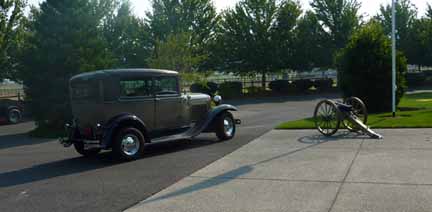
Heading back with a hat full of blackberries, I hitch a ride with Matt. He points to the fence I'd shinnied through. "I'm gonna put a gate in there," he says. And I know he's not joking. It's not long before Roy shows up. On his day off, he knows Matt will be out there trying to fix that break, and he wants to help. He arrives in style.
Matt's boneyard has just the piece of pipe they need. Roy scoots on home, threads it, and hurries on back. As for that fence . . .
The gate will follow. If he says he's going to do something, my man doesn't mess around. Tuesday, August 20. Living in the country can lead to some strange conversations. This morning Matt called the Grants Pass Irrigation District, for convenience known to everyone as GPID. The conversation went like this: Matt: "Today's our ditch day, but I just went and looked and there's no water." GPID: "The ditch rider's out looking for it. When he finds it, we'll call you." I swear I did not make this up. H2O, phone home. So we occupied ourselves with a few town errands. Upon our return, Matt went and checked the ditch. He says, "It's now running about half beaker." Don't look at me; I just report what I see and hear. I guess the ditch rider found some of the missing agua, anyway. Wednesday, August 21. Roy, going in to town this morning, offers Matt a ride to pick up his Road King. Passing the east fields, they both allow as how things are looking mighty green. "Where's that water coming from?" wonders Matt. "From your pond, of course," says Roy. "You mean you didn't connect the outgoing trench back to the incoming ditch?" "No, was I supposed to?" That's OK. Matt has had another epiphany requiring Roy's big machine, anyway. As he explains it to me, "I'm going to have Roy take all that clay he dug out and shove it over against the far bank, building a berm high enough to create, eventually, a pleasant viewscape." Well, now, you just know that if Mr. Matt has set his mind to something, it will happen. Thursday, August 22. A spectacular morning thunderstorm takes us unawares Matt down at the winery and me at the house counting seconds between flash and bang "one Mississippi, two Mississippi" hoping to get to five or so in between and trying to remember whether he had gotten his suspenders straight in this proper Midwest flash-banger and some of it striking quite close and he hasn't even taken his cell phone it rings at the bar when I call do you leave your windows open or closed I can't remember and where are you, Matt, where are you Then he comes striding in, only a little wet, only a little wide-eyed. "Bang!opolis is out in full force," says he. And so we sit together on the covered patio and watch it— for when something is that much bigger than you, all you can do is watch— and by and by the rumbling abates and the animals venture out and the breeze comes clean and sweet, and I go for my camera knowing that when the sun peeks through there will come a most glorious bow . . . It's like the storm we went through with the Posts and Poles. And then the clearing skies that have come with new management. You see, under our old structure we paid a (large) sum of money up front to a company that promised, in return, to provide all materials and labor. Under our new structure, where we are in control, we will KNOW the materials will be delivered because they're paid for. We will KNOW the workers are getting fed. We will KNOW the men (and women) are getting paid. Because WE are now taking care of it. Directly. Tuesday, August 27. It's a day for planning and moving: planning irrigation lines and moving more dirt. Dave Bower sits down with us to explain how he's mapped main lines and risers, Ts and valves.
And Roy arrives to further dig out and expand that pond and build a berm. But first, buried lines have to be located, lest future expansion ruin them. What buried lines, you wonder? Well, before we can hook up septic services to that nice ADA bathroom in the winery, we have to find out exactly what lies beyond. Matt does the honors. With a trowel, lest he hit something.
What his work reveals is a mini labyrinth of pipes and wires.
Where in the heck do they all lead? Roy is going to show us. By dowsing.
"Are you blood type positive or negative?" Roy asks me. "A-Positive." "Good. You should be able to dowse. Positives do better than negatives," and he shows me how to hold the wires, loosely and parallel, so they can swing of their own accord.
But the wires don't swing together for me, the way they did for Roy when he located the water line under our driveway, or the water line going from the pipes Matt had exposed.
Roy proceeds methodically to map all lines exiting the winery, marking with a scrape of his heel in the dirt whenever he encounters buried treasure. We are convinced. "Some have called it witchcraft," says Roy. "No," I reply. "It's just science we don't understand yet." Roy climbs back up in the cab of his excavator, in pursuit of Matt's directive for today: deepen and widen the pond. Push the topsoil to one side, dig out the clay and pile it up as a berm to the east.
"What shape do you want it? A crow, or a bear?" asks Roy. He's the fellow who could do it, too.
Roy's son, Rod, mans a front-end loader, pushing the clay Roy dredges up to the east bank, where it will provide an amphitheater effect upon which, one day soon, will grow as-yet-to-be-determined shrubs. Father and son drive the machines in a graceful, though cumbersome, dance. Rod pushes, Roy shoves. Their collaboration is mesmerizing to watch.
Something catches Roy's eye. I watch as he brings it up from the depths, swinging bucket gently towards cab until he can pluck therefrom ... . . . a glittering piece of agate? quartz? He tosses it to us for our inspection. "Quartz," he calls out. "It's a sign of water."
The dance continues, the push and shove, the dredge and scoop and pile . . . . . . until Roy stops, stares, beckons us forward to see bubbles rising through the muddy water, bubbles from . . .
. . . an artesian spring, gurgling up from the newly dug depths. We have struck water, more precious to a farmer than gold. I am not surprised to learn that Roy is a Pisces. Wednesday, August 28. Today Roy and Rod returned, their objective to install the waste tank for the winery and to dig trenching to the house's septic tanks which, since they are 1,500 gallons or greater and have two chambers with an effluent filter, we can use to process bathroom waste from the winery. Two men, a machine, and a deep hole later, the tank is ready to be installed. Roy and Rod fasten tank to machine
then Roy lifts it
and lowers the tank into the hole.
Then it's time to dig a l-o-n-g trench to the house, using the existing culvert to traverse the road.
So I'm in the house, going about my housely affairs, and the phone rings, and it's Matt, on his cell phone. Surprised that he would call to chat amid such a flurry of activity, I chuckle for a moment, and then he says, "I just needed to know if our phone is working. Call Brian and Teresa, call Alex and Michael, and make sure their phones are still in service. We've broken a line." I go out to tell him the neighbors are all right, and find him up to his neck in the trench, checking the broken line with a voltmeter.
"No volts here on either side," he calls out. "It's got to be the abandoned phone line to the electric gate that we dismantled when we bought the place because it looked like a one-armed bandit." Let's hope. Friday, August 30 Dave Bower delivers our irrigation supplies. Finally, they're here--because we paid for them . . . twice, actually, if you count the big bucks put up front to the vineyard management company that didn't work out, the management company that was supposed to broker this for us-- and it feels good to be in control of our own project. Matt checks out our stash.
They'll all go in the deep trenches that at this very moment are being dug. Finally. Because we paid for it. Twice.
These trenches in the field will receive irrigation pipe, locator lines, and data lines. The same lines have to go to the west fields, in the trench in front of the house.
But to get to that west trench, pipe, locator lines, and data lines all have to transit through the culvert under our road. I wish I'd gotten the picture on that one. The pipe, being rigid, goes through just fine. and the locator line, being semi-rigid, goes through, though here's Matt, on haunches at one end of the pipe, waving the line as best he can, like a long long wand, and calling to Roy, "There it is, see it? Right in front of your face." "It's ten feet away," calls Roy. Hard to judge distance through a twelve-inch culvert, I guess. Anyway, pipe is through, locator line is through, but data line is just too limp. No amount of coaxing will stiffen it. "Hang on," calls Roy. "I'll phone Rod and have him bring a fishing line." Not that kind. Seems it's an electrician's "fishing line," a flexible though semi-rigid metal line that can be played through the culvert from the receiving end, until someone at the sending end can tape the data line to it. And that's the way it was. And I'm sorry I missed it. Sounds like an interesting fishing expedition. Saturday, August 31. Matt is in his element. That stash of plumbing supplies must all be preassembled, joint and valve and pipe and elbow and such, all must be glued and threaded in just the right way. Michael guides this phase of the operation. They work together most of the morning. Later, Matt tells me Michael said, "Of all the vineyard owners I've worked with, you are the most hands-on." "That's because I want to understand it all," Matt replied.
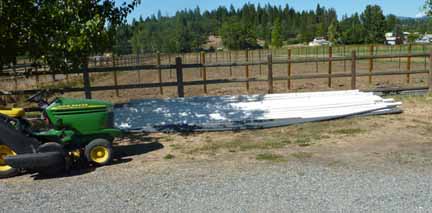
Out in the fields, the pipes are laid beside their ultimate resting places, awaiting Roy's return.
We're on our way toward that full-fledged irrigation system, one of the vital keys to the success of the Crow and Bear Vineyards. Monday, September 2. Labor Day. The risers that Michael and Matt preassembled wait to be attached to sub mains and lowered into trenches throughout the vineyard.
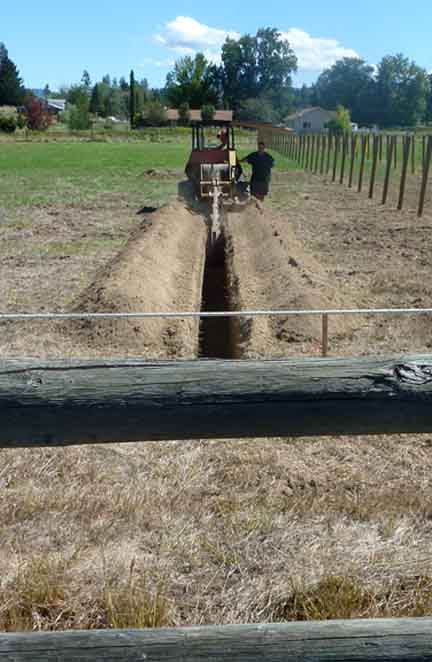
Here comes the trencher man, making his way across the west field.
The trencher chews its way through the field, moving as slowly as the proverbial mills of the gods, but, like those mills, immutably changing the ley of the land. The objective today is to avoid breaking any buried lines. We know where they are--within a few inches or so, laterally, and within a foot or so, vertically-- but that still leaves room for unintended consequences, as we've already discovered a time or two. So Matt asks the trencher man to run shallow in the suspect areas. Then, later, he climbs in the trench and finishes the excavation by hand.
This time it worked. No broken lines. Wednesday, September 4. A busy day at the Crow and Bear. Matt is, as he says, en charrette, rushing here, rushing there on his little John Deere mower/tractor (we have got to switch that out for a more seemly Quad: it simply does not do for The Baron to be running around on a lawnmower). Danny York of York Electric, here to move the [very noisy] electric control panel from inside Michael's office to outside ("He's been begging me," says Danny), confirms that Matt could use a Quad. "But I haven't mocked him," says Danny with a twinkle. "Good," I reply. "The Baron must always be treated with courtesy and respect." Out in the fields, a clot of activity in pursuit of some elusive water lines. "The gods are fooling with us," says Michael. "We've got pipes with no photos to document them, and photos of pipes that aren't there."
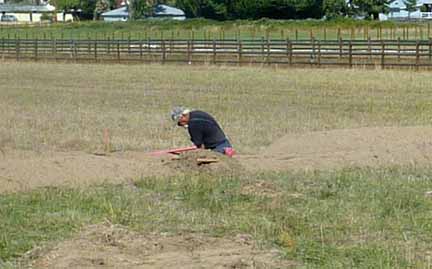
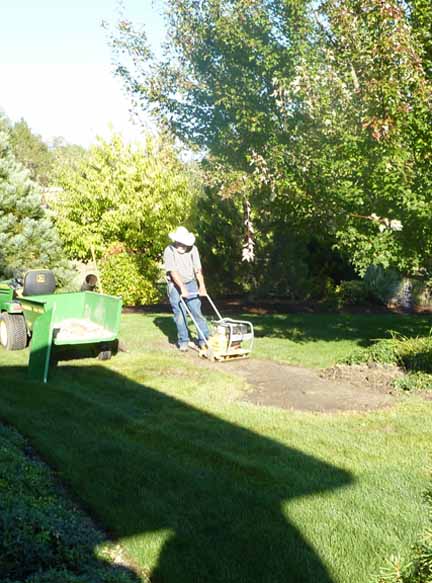
"Roy, what are you doing on the working end of that shovel?" I call. "Couldn't find the motor," he calls back. But the pipes remain a puzzlement. I learn at lunch that Roy has brought out his sticks and set to dowsing. He swears there's a buried pressure line in the north end of the east field, but no records exist, nor reason that we can tell, confirming such a line. Sounds as if we're going to have to dig to discover. Finding such an unknown would save about 500 feet of 4" line, a not inconsiderable investment, so it's worth exploring. Investigation will resume after lunch. So the noisy electric control panel in charge of the 7hp pump that furnishes pressurized water through all the lines and risers attached thereto, the noisy electric control panel that Danny and helper have finished moving, is ready to test. Danny and Matt are standing on the north side of the winery, near one of the irrigation lines, and the command is given to test the newly moved control panel on the south side of the winery. Command received, helper complies, control panel is turned on, pump fires up, water courses through the lines and up the open riser Danny is standing beside, the riser Matt had forgotten he'd left open, and from a drenched Danny, sputter, sputter, "Turn off the [_] pump!" He was really very nice about it, all things considered. Sunday, September 8. Vineyard posts and poles, irrigation, winery: all are intricately connected. So, friends, for the next part of the story I must direct you back to Chapter Three: The Winery where you will meet a very different kind of mole. But I'll see you back here another day; we're not finished with irrigation. Sunday, September 15. The Calm Before the Hubbub The Baron had been laboring hard in the trenches— literally, in the trenches. And then filling in the trenches and compacting the soil.
He needed a break; my birthday seemed like a good enough excuse, one for which he would abate his pouring in of sweat equity to honor, for a day or so, his Baroness (for since the Humboldt County ranch, that has been our fond names for each other: The Baron and The Baroness of the Crow and Bear, and so it continues).
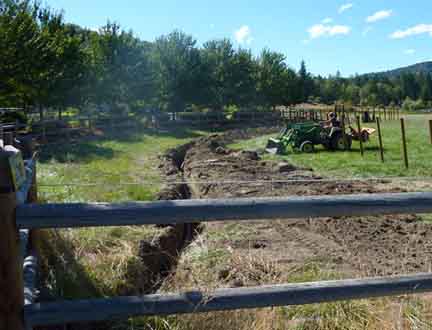
We returned to an unusually tranquil scene at our usually busy, sometimes hectic vineyard home. Risers hang limply beside sub-main lines, awaiting their lowering into the trenches crisscrossing the land.
Valves, now assembled and glued, are ready to be installed.
At the winery, door frames are in place.
Tools are ready and doors await hanging.
Tomorrow will be a beehive of activity.
We're enjoying the calm before the hubbub. Saturday, September 28. Who knew it could get this complicated? We've been dealing with pipes and trenches, ripping and tilling the soil, and a mountain of bureaucratic paperwork, all at once. Now the prediction is for a little serious rain. Matt and Michael rush to get the last of the pipe laid and trenches filled. Risers peek out from lines already buried in trenches . . .
. . . but hundreds of feet remain to be buried. I come out to watch. Michael mans the little tractor. It's a tight squeeze between wooden end poles.
Matt tells me he's just received a call from his good friend Harry Hull, at home in Brazil, who asked where he was. "Up to my [rear] in a trench," Matt replied. "Now," says Michael, "we have to prevent planting him too soon."
The sky lowers. Rain is surely on the way. Matt and Michael hurry to finish before the downpour. Wednesday, October 9. The trench that carries the waste line from winery to house has been lying open, awaiting yet one more visit from Roy. Seizing that problem (needing to pump effluent up to the house through a purpose-built trench) and seeing in it the seeds of opportunity, Matt asks Roy to spread the excavated soil in the tractor row and back-fill the trench, instead, with slate. Ingeniously, this will act as a French drain to capture run-off from the house's landscaping and prevent its over-watering the future vines. Roy arrives with his dancing dinosaur.
There he is, swinging her around as if they were on a dance floor.
Though it takes 50 cubic yards of slate to fill the trench, it's worth it to protect the vineyard from orchard and driveway runoff. To our delight, the finished product resembles a streambed meandering through the head of the field.
And now, my dears, it's back to Chapter Three: The Winery for a tale of suspense and heartbreak, hope and frustration, a tale that is still in the making as we wrestle with The Other Powers That Be and with our own emerging understandings. March 23, 2014 Speaking of emerging understandings, our most recent encounter with The Powers That Be borders on the surreal. Rain water, we are informed, belongs to the state of Oregon. Because it belongs to the state of Oregon, it may not be allowed to flow into an irrigation pond. Water that falls from the sky and makes its way to a pond naturally, courtesy of gravity, is considered to be impounded. Who'd have thought? Now, once the state is aware that you have some surface water flowing naturally into a man-made pond, even though that water exits the pond through the overflow pipe, you must either build a berm to restrain said water from entering said pond, or you must pay the state $1,000 for a permit to allow you to leave your pond as is. Go figure. Well, what would you do? Matt decided he'd rather pay Roy to build a berm: at least then, private enterprise profits. So build a berm Roy did.
And a handsome one it is. So handsome we've decided to dig out around that standpipe and convert it to a water feature. What's the mantra? Repeat after me: "Bless those who disappoint you, for they are leading you toward a better path." The blocks were such a great buy on close-out that we bought the whole load. They'll all be covered with DG (decomposed granite) in the manner you see in the lower right foreground.
Notice anything different about the pond now? (Other than the berm.) Notice how much fuller it is? (Hint: Matt's not a Pisces for nothing.) Remember the overflow pipe through which water exits the pond? (Hint: it used to be a straight line.) Look at it now.
Matt added an elbow, which by and by raised the water level in the entire pond by the depth of said elbow, thereby increasing the volume by the depth of the elbow times the new circumference of the pond. Matt says this added 5,500 gallons, making the new volume of the pond a little over an acre-foot. Pretty slick, says I. April 25, 2014 It's all about the vines: the soil ripping and tilling, the trenching and burying line, the stringing of the wire . . . and those vines are coming soon. Give us a month and a week and you'll see a big rig arriving, our baby vines aboard. But they won't grow well in weedy soil, so now's the time to spray. Yellow stripes testify to the herbicide's effectiveness.
Are those black tires set out at the heads of the rows?
Nope. Just rolls of half-inch drip line, waiting to be strung. The drip line will be hung on the first tier of wire, already in place. Look closely and you'll see it glimmering a little below knee level. By the time this vineyard is complete, we will have strung 96 miles of wire. Matt trundled a lot of that wire himself, hauling it over his shoulder as it unwound from the spinning jenny mounted on his Polaris. Down the row hauling, trudging back empty for another load, Matt said he felt like a mule. Figuring there had to be a better way to manage time and effort, to lay out the drip line Matt installed a second spinning jenny on the back of our Ranger. Then, tucking the free end of the tubing under his bottom, he'd zip out to the end of the row, where he'd drop the tubing, zip back, clip off the length just laid, and pick up a new end from Jenny.
Saved a whole lot of mule work. Early June Now it's all about getting water from pond to plants. Ewing Irrigation delivers, and Matt and Michael install, a huge, expensive filter for the main pond pump. 'Twould never do to get detritus or a froggie sucked into the lines.
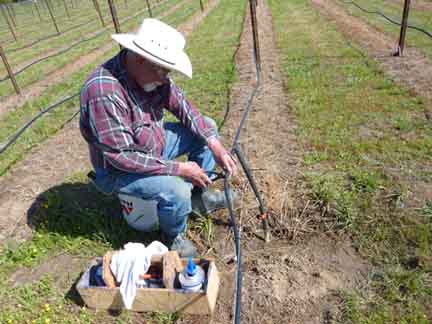
From the pump, water will course through sub-mains to risers to drip lines, where emitters will deliver, drop by precious drop, the fluid that the magical vines will transmute to juice that will become wine. Now it's all about connections. Matt splices riser to drip line.
Time to test those connections. Fire up the pump and watch the clean-out line. "Thar she blows!"
Test the risers, flush the lines.
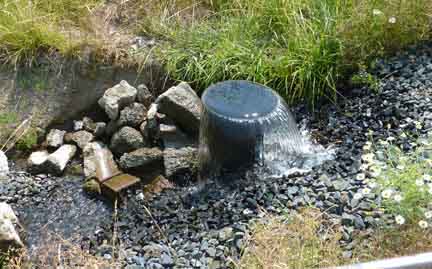
All systems go. We have launch. Now, at last, at long, long last, it's time for the vines. Newest Posting July 12, 2014 Mid-July. With a burble and a glurp, The Ditch diligently delivers its flow to the pond. At the outlet, excess spills over, as it has done every day this month, even when The Ditch is not running. At the moment we are fertigating half the vineyard, about 6,000 vines. Clearly, our water situation is now quite favorable.
Chapter One: Poles and Posts Chapter Three: The Winery Chapter Four: Cultivation Chapter Five: The Vines Home